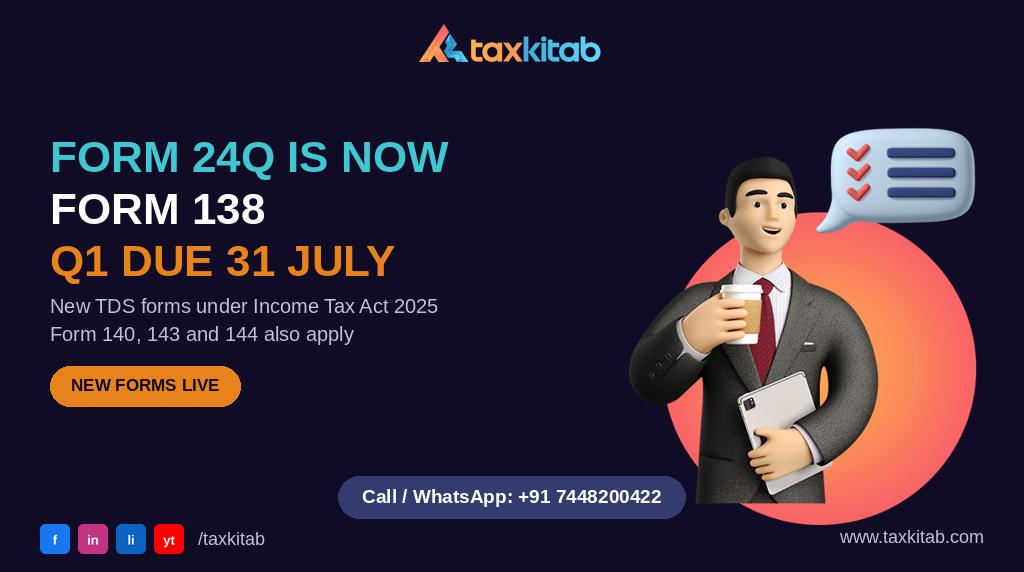
If your payroll software still says “Form 24Q” on the Q1 screen, you have a problem. The Income Tax Act 2025 came into force on 1 April 2026, and with it came an entirely renumbered set of TDS and TCS return forms. The TDS return Form 138 replaces Form 24Q for salary TDS from Q1 of Tax Year 2026-27.
Form 140 replaces Form 26Q, Form 144 replaces
Form 27Q, and Form 143 replaces Form 27EQ. All four are due on 31 July 2026 for the April–June 2026 quarter. Software still showing old forms? Send us a screenshot on WhatsApp and we will tell you whether your Q1 return will pass validation. Message TaxKitab
Quick Summary
| Item | Detail |
| Old form → new | Form 24Q → Form 138; 26Q → 140; 27Q → 144; 27EQ → 143 |
| Q1 period | April–June 2026 |
| Due date | 31 July 2026 |
| Applies to | All deductors filing TDS/TCS statements |
💡 TaxKitab Tip The date change that will catch the most collectors is the TCS one. Under the old law, Form 27EQ for April–June was due on 15 July. Under the new law, Form 143 follows the TDS calendar and is due on 31 July. Every TCS collector who kept a 15 July reminder in their calendar has now either filed early or, more likely, assumed they had missed it. Check which one applies to you before you pay a late fee you do not owe. — From our TDS & TCS Book 6. Available at taxkitab.com/books (₹249)
The rule that decides which form you use
This is the part people get wrong. The form is decided by the period of the deduction, not by the date you file. Q4 of FY 2025-26 covers January to March 2026. Even if you file that return in May or June 2026, it goes on the old Form 24Q or 26Q, under the old Act, with old section numbers.
A revised or belated Q4 return filed in September 2026 still uses the old forms. Q1 of Tax Year 2026-27 covers April to June 2026. That return uses Form 138, 140, 143 or 144, under the Income Tax Act 2025. Do not mix the two.
A Q1 return filed on Form 24Q will throw a validation error, and a correction cycle in the middle of ITR season is not how anyone wants to spend August.
Sections have changed too, not just form numbers
Under the old law, you cited Section 192 for salary, 194C for contractors, 194J for professional fees. Those section numbers no longer exist for periods from 1 April 2026. Salary TDS now sits under Section 392. Non-salary resident TDS has been consolidated into Section 393, which carries a single schedule of payment types with numeric payment codes instead of individual sections.
When you file Form 140, you report the payment code, not “194J”. The rates themselves are largely unchanged. What changed is how you reference them — in your challans, in your return, and in the certificates you issue. ⚠️ Verify the exact payment code for each payment type at incometax.gov.in before filing. The code list is long and the wrong code is a correction statement waiting to happen.
The certificate side, which most people forget
Filing the return is only half the obligation. For salary, the annual certificate your employees know as Form 16 is now Form 130. It can only be generated from TRACES after the return is filed. You cannot type one up yourself.
For non-salary payments, the certificate is issued after each quarterly return, within 15 days of the return due date. For Q1 filed by 31 July, the certificate goes out by 15 August 2026. The employee declaration you collect at the start of the year — rent, home loan interest, Chapter VI-A investments — was Form 12BB. It is now Form 124.
If your HR team is still circulating a Form 12BB template, that template is out of date.
What late filing actually costs
The ₹200-per-day late fee continues under the new Act. It runs from the day after the due date until the return is actually filed, and it cannot exceed the total TDS or TCS reported in that return. That cap sounds protective until you do the arithmetic. A Q1 return with ₹80,000 of TDS, filed 60 days late, attracts ₹12,000 in fees.
Filed six months late, the fee hits the ₹80,000 cap. Interest on late deposit is the more expensive exposure, and it is the one that catches people. Interest runs at 1.5% per month from the date the tax was deducted, not from the 7th of the following month. One day’s delay in deposit therefore attracts a full month of interest.
The five-minute check to do this week
Ask your software vendor, in writing, one question: does your Tax Year 2026-27 release map the Q1 return to Forms 138, 140, 143 and 144? If the answer is anything other than a clear yes, you are filing manually or you are filing late. Then run a bulk PAN verification of every deductee on TRACES before you upload. A wrong or inoperative PAN means the credit never reaches the deductee’s tax records — which turns your compliance problem into your client’s or employee’s problem, and eventually into a correction statement for you. Finally, check your June challans.
TDS deducted in June was due for deposit by 7 July 2026. If that slipped, fix the interest calculation before the return goes in, not after TRACES flags it.
Frequently Asked Questions
Do I need a new TAN under the new Act?
No. Existing TANs continue unchanged. Only the return and certificate form numbers have changed, not your registration.
Can I still file a correction for an old Form 26Q?
Yes. Corrections for periods up to 31 March 2026 continue under the old Act and old forms. Do not file a FY 2025-26 correction on Form 140. Our TCS return was always due on 15 July.
Is that still right?
No. From Tax Year 2026-27, the TCS statement is Form 143 and follows the same 31 July Q1 due date as the TDS returns.
What if I deducted TDS in June but deposited it in July?
The deposit was due 7 July 2026. If you deposited late, interest runs at 1.5% per month from the date of deduction — not from 7 July. Compute it before filing.
References
- Income Tax Act 2025 — Sections 392, 393, 397 Income Tax Rules 2026 — Rule 219 (Forms 138, 140, 143, 144)
- Income Tax Department form list, Form No. 143 (earlier Form No. 27EQ)
How This Connects
This connects directly to our Q1 TDS return checklist and the wider Income-tax Act 2025 changes. If your certificates are not matching, our Form 16/16A mismatch fix covers the TRACES side.
Call or WhatsApp: +91 7448200422 · See our TDS Return service or Contact us. Our TDS & TCS Book 6 (Rs 249) walks through the new forms.
Related Reading
Need help with this? TaxKitab handles TDS Return Filing for businesses across India and overseas. Talk to us.