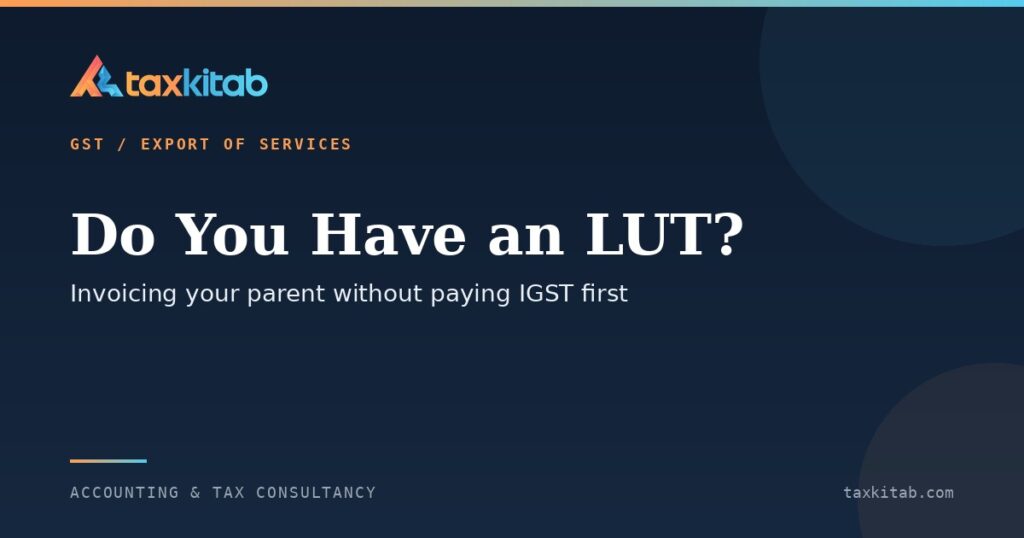
An India subsidiary doing engineering, back office or support work for its overseas parent raises a monthly invoice to the parent. Straightforward enough — until someone asks whether IGST should have been charged on it, and the answer turns out to depend on a one-page form nobody filed.
Where an India entity supplies services to a foreign parent, the supply is generally an export and therefore zero-rated. Filing a Letter of Undertaking in Form GST RFD-11 lets you invoice without charging IGST at all. Without it you must pay IGST and then claim it back, which locks up working capital for months.
Invoicing your parent from India? WhatsApp us and we will check whether your LUT is current.
Quick Summary
| Question | Answer |
| What is an LUT? | An undertaking in Form GST RFD-11 to export without paying IGST |
| Where is it filed? | GST portal, Services > User Services > Furnish LUT |
| What does it cost? | Nothing |
| How long is it valid? | One financial year, April to March |
| What if I do not file it? | Pay IGST on export invoices, then claim a refund |
| Multiple GSTINs? | A separate LUT for each registration |
Is Invoicing Your Parent Actually an Export?
Worth settling first, because the LUT only matters if the supply is zero-rated.
Export of services requires the supplier to be in India, the recipient outside India, the place of supply outside India, payment received in convertible foreign exchange, and the supplier and recipient not to be merely establishments of the same person.
That last condition worries foreign groups, and it should not. A branch or liaison office is part of the same legal entity as its head office, so a supply between them is not an export. A subsidiary is a separate legal entity from its parent. Services supplied by an Indian subsidiary to its foreign parent are therefore treated as exports.
The practical points that do bite are the other two. Payment must come in convertible foreign exchange, so a rupee settlement against an intercompany balance creates a problem. And the proceeds must be realised within the prescribed period, which for services runs from the invoice date.
What the LUT Does
Two routes exist for zero-rated supply. Pay IGST on the export invoice and claim a refund afterwards, or file an LUT and invoice without IGST at all.
The second is obviously better. The refund route means paying tax on money you have not yet collected, then waiting on a refund claim with its own documentation and scrutiny. For a subsidiary funded by its parent and already tight on cash, that is a self-inflicted problem.
Filing costs nothing. It takes a few working days to be accepted.
Filing It
On the GST portal, under Services, then User Services, then Furnish Letter of Undertaking. Select the financial year, provide the name, address and occupation of two independent witnesses, tick the self-declarations, and submit using DSC or EVC. An ARN is generated on submission.
If you have multiple GST registrations across states, each one needs its own LUT.
The eligibility bar is low. The main disqualification is prosecution for tax evasion above a prescribed threshold, which will not apply to most businesses.
The Part That Catches People: It Expires
An LUT covers one financial year, from 1 April to 31 March. It does not roll over.
A fresh LUT must be filed for each financial year before your first export invoice of that year. File it in March for the year beginning in April and the question never arises.
Miss it, and export invoices raised before the new LUT is in place attract IGST. That has to be paid and then reclaimed, which is precisely what the LUT exists to avoid. This is the most common LUT failure and it is entirely a calendar problem.
Put it on the annual compliance calendar next to the other March items. It takes minutes and costs nothing.
The Undertaking Has Conditions
An LUT is a commitment, not a formality. You undertake to export within the prescribed time and to comply with GST law on exports. For services, export proceeds must be realised within the prescribed period from the invoice date.
Where the condition is not met, IGST becomes payable with interest. For a subsidiary billing its parent this is rarely a problem in principle — but intercompany invoices do get settled late, precisely because both sides are in the same group, and the clock does not care.
Reporting It Correctly
Exports under LUT are reported as zero-rated supplies without payment of tax. They appear in the export table of GSTR-1 and the zero-rated line of GSTR-3B, and must reconcile to your books and your annual return.
Where the entity has input tax credit accumulating against these supplies, that credit can be refunded under a separate application, which is a common position for a subsidiary with no domestic sales.
Frequently Asked Questions
Our India entity only invoices our parent. Do we still need GST registration?
Zero-rated does not mean outside GST. Registration requirements apply on their own terms, and an LUT presupposes you are registered.
We forgot to file the LUT this year. What now?
File it now. Invoices raised before it is in place attract IGST, which is paid and then claimed back. Later invoices are covered once the LUT is accepted.
Does the LUT cover all our GST registrations?
No. Each registration needs its own.
Is there a fee?
No. Filing and renewal are free on the GST portal.
Our parent pays in rupees from an Indian account. Does that matter?
Yes. Export of services requires payment in convertible foreign exchange. Settlement in rupees puts the export characterisation at risk and should be reviewed.
We are a branch office, not a subsidiary. Same position?
No. A branch is part of the same legal entity as its head office, so the supply is not an export. The analysis is different and needs advice.
References
- IGST Act, 2017 — Section 2(6), export of services, and Section 16, zero-rated supply
- CGST Rules, 2017 — Rule 96A, export without payment of IGST
- Form GST RFD-11 and GST portal user guidance on furnishing an LUT
- CGST Act, 2017 — return reporting for zero-rated supplies
⚠️ Conditions, timelines and thresholds change through notification, and whether a particular supply qualifies as an export depends on your structure and contracts. Confirm your position with your advisor before invoicing without IGST.
Call or WhatsApp: +91 7448200422 Email: info@taxkitab.com See our GST Return Filing service, or explore Global Desk if your parent sits outside India.
A full list of what we handle, in India and overseas, is on our Services page.
Related Reading
- Payroll in India for a Foreign Company: PF, ESIC, PT, TDS
- Outsourced Bookkeeping for US Small Businesses
- Why Outsource Your Accounting to India? Cost, Quality & Time-Zone Benefits
Need help with this? TaxKitab handles Global Payroll for businesses across India and overseas. Talk to us.