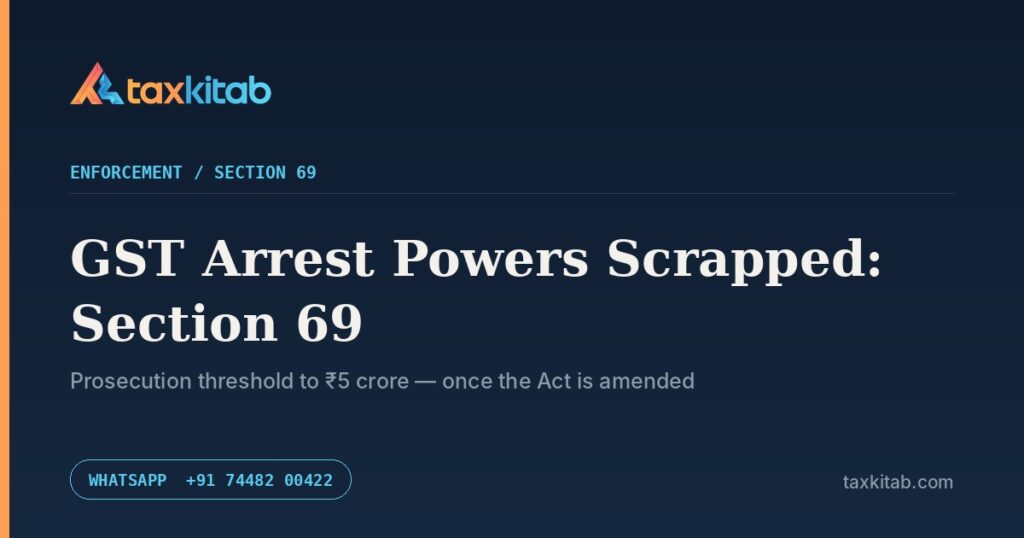
The power to arrest has sat in GST since 2017 and has been the single most contested feature of the law. The 57th GST Council has recommended removing it outright — not narrowing it, not raising its threshold, but omitting the section.
The Council has recommended omitting section 69 of the CGST Act, which gives the Commissioner power to authorise arrest, and raising the prosecution threshold from ₹1 crore to ₹5 crore of tax evaded. Section 132 is to be reworked and the mandatory minimum punishment dropped. This needs an amendment to the CGST Act and matching State GST Act amendments, so section 69 remains in force today.
Facing a summons, a search or a notice alleging evasion? WhatsApp us the details and we will tell you where you stand under the law as it currently is.
Quick Summary
| Item | Position today | Recommended |
| Power of arrest | Section 69, Commissioner may authorise | Section 69 omitted entirely |
| Prosecution threshold | ₹1 crore of tax evaded | ₹5 crore |
| Section 132(1) clause (i) | In force | Removed |
| Section 132(1) clause (c) | Wrongly availed or utilised ITC | Narrowed to fraudulent availment |
| Clauses (e) and (h) | In force as worded | Certain words deleted |
| Mandatory minimum punishment | Prescribed | Dropped; fine, imprisonment or both, at judicial discretion |
| General penalty, section 125 | Up to ₹25,000 | Up to ₹10,000 |
| Show cause notice | No monetary floor | No SCN below ₹10,000 total tax |
💡 TaxKitab Tip None of this changes how you should respond to a summons today. Section 70 — the power to summon a person to give evidence and produce documents — is untouched by these recommendations and is the provision most businesses actually encounter. Attend, take your records, answer what is asked, and do not sign a statement you have not read. The arrest debate is about the far end of the process; the summons is where most cases are won or lost, and the recommendations do not alter it.
What Section 69 Does Today
Section 69 of the CGST Act empowers a Commissioner, where he has reason to believe a person has committed an offence specified in certain clauses of section 132(1) and the offence is punishable under section 132(1)(i) or (ii), to authorise any officer to arrest that person.
Two features have made it contentious. The arrest can precede any adjudication — there need be no determination of the tax due, no order, and no finding by any authority that an offence occurred. And the threshold has been ₹1 crore of tax evaded, which in a business of moderate size is not a large figure, particularly where the allegation concerns input tax credit rather than tax collected and not paid.
Courts have constrained its use repeatedly, and the Supreme Court has laid down requirements on recording grounds of arrest. But the power itself remained.
What the Council Recommended
At its 57th meeting on 8 October 2026, the Council recommended:
Omitting section 69. Not amending it, not raising its threshold — removing the section from the Act.
Raising the prosecution threshold from ₹1 crore to ₹5 crore of tax evaded.
Reworking section 132. Clause (i) of section 132(1) is to be removed. Clause (c) — currently covering availing input tax credit using an invoice or bill referred to in clause (b) — is to be narrowed to fraudulent availment of ITC. Certain words are to be deleted from clauses (e) and (h). Punishments are to be rationalised.
Dropping the mandatory minimum punishment, so that fine, imprisonment or both sit with judicial discretion rather than being prescribed as a floor.
The narrowing of clause (c) is the quietly significant one. A great many prosecutions and arrests under GST have concerned ITC said to be wrongly availed, in circumstances where the buyer’s conduct was not in question and the supplier was the problem. Requiring fraud rather than mere wrongness changes who is exposed.
Why It Is Not Law Yet
Section 69 and section 132 are provisions of the CGST Act. Removing or amending them requires an amendment Act passed by Parliament, and matching amendments to each State GST Act passed by every state legislature, because GST operates as parallel central and state statutes.
This is the slowest route a Council recommendation can take. Rule changes can be notified in weeks. Act amendments ordinarily travel with a Finance Bill and then wait on state assemblies.
Until that process completes, section 69 remains fully in force, the prosecution threshold remains ₹1 crore, and section 132 reads as it does today. The PIB release says expressly that the recommendations “would be given effect through the relevant circulars, notifications and law amendments.”
What Is Not Affected
Section 70, summons. The power to summon any person to give evidence or produce documents is unchanged. This is what most businesses actually face.
Section 67, inspection, search and seizure. Unchanged by these recommendations.
Provisional attachment under section 83. Unchanged.
The tax demand itself. Removing arrest and raising the prosecution threshold does not reduce anyone’s liability. Tax, interest and penalty under sections 73 and 74A are unaffected — what changes is the criminal consequence sitting alongside them.
That distinction matters. A business that reads this as a softening of GST enforcement generally has misread it. Enforcement is being moved out of the criminal track and into assessment, penalty and recovery, which the same meeting strengthened in other respects.
The Related Relief on Penalties
The same meeting recommended a set of changes that matter more day to day than arrest does for most taxpayers.
The general penalty under section 125 falls from ₹25,000 to ₹10,000.
A ₹10,000 floor applies to show cause notices, measured across CGST, SGST, IGST and cess together, with pending notices below that amount to be treated as if the threshold had applied.
In non-fraud cases, a 5% reduced penalty applies where tax and interest are paid within 30 days of the order under section 73, or 60 days under section 74A, and the ₹10,000 minimum penalty in non-fraud cases is removed.
Pre-deposit on penalty-only appeals is capped at ₹40 crore under sections 107(6) and 112(8).
A circular is also recommended on the quality of notices and orders, the use of fraud allegations, and observance of natural justice — which, if it has teeth, may do more for the average taxpayer than the arrest change.
How This Sits With the Rest of the Meeting
This was one item in the largest single set of procedural recommendations GST has seen, and the full list with status against each is in the 57th GST Council meeting summary. The two with the widest commercial effect are ITC on employee health and life insurance and the automation of registration amendments and cancellation. Businesses whose exposure sits in credit mismatches rather than in anything criminal should start with getting the annual return and reconciliation right.
Frequently Asked Questions
Can I be arrested under GST today? Yes. Section 69 remains in force until the CGST Act is amended. The Council has recommended its removal; that recommendation is not law.
Has the prosecution threshold already gone up to ₹5 crore? No. It remains ₹1 crore until the Act is amended.
Does this wipe out pending prosecutions? Nothing announced says so. How pending matters are treated will depend on the transitional provisions in the amending Act, which do not exist yet.
I have received a summons under section 70. Does any of this help? No. Section 70 is untouched. Attend, carry the documents listed, and take professional advice before giving a statement.
Is the tax demand reduced? No. These recommendations concern arrest, prosecution and penalties, not liability. Tax and interest under sections 73 and 74A are unaffected.
When will the amendment happen? No date has been announced. Act amendments of this kind ordinarily move with a Finance Bill, followed by state legislature amendments. Watch cbic.gov.in rather than commentary.
References
- PIB, Ministry of Finance — “Recommendations of the 57th Meeting of the GST Council”, Press Release ID 2320934, 8 October 2026
- CGST Act, 2017 — Sections 67, 69, 70, 73, 74A, 83, 107(6), 112(8), 125 and 132
⚠️ Omitting section 69 and amending section 132 require an amendment to the CGST Act and matching State GST Act amendments. Neither has happened. Section 69 is in force. If you are facing enforcement action, take advice on the law as it stands rather than on recommendations.
Call or WhatsApp: +91 7448200422 | Email: info@taxkitab.com
See our GST Return Filing and Managed Compliance services if keeping the file clean is the aim rather than arguing about it later. Get in touch.