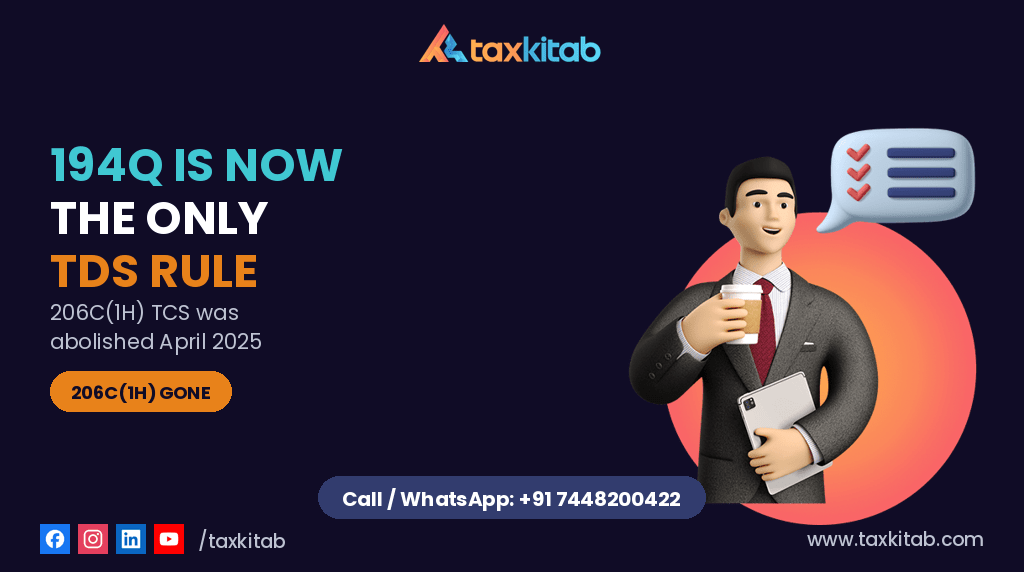
If you’re still running a “which one applies, 194Q or 206C(1H)” comparison in your head, or worse, in your billing software, drop it. One side of that comparison no longer exists.
The Finance Act, 2025 abolished Section 206C(1H), the TCS-on-sale-of-goods provision, effective 1 April 2025. Section 194Q — TDS on purchase of goods, deducted by the buyer — is now the sole provision governing these transactions.
Still seeing TCS lines on your invoices after April 2025? WhatsApp us — that’s a configuration issue we can help fix.
Quick Summary — Before and After 1 April 2025
| Before 1 April 2025 | From 1 April 2025 | |
| Buyer-side obligation (194Q) | TDS at 0.1% on purchases above ₹50 lakh, buyer turnover above ₹10 crore | Unchanged — still applies |
| Seller-side obligation (206C(1H)) | TCS at 0.1% on receipts above ₹50 lakh, seller turnover above ₹10 crore | Abolished entirely |
| When both used to apply | 194Q took priority; the seller didn’t collect TCS | Not applicable — there’s no seller-side rule left to compare against |
Why the Government Removed It
Here’s the official rationale. Section 206C(1H) duplicated oversight that Section 194Q already provided from the buyer’s side. GST data already gave the department transparency into the same transactions. The compliance burden on sellers — tracking every buyer’s cumulative receipts, flagging the ₹50 lakh crossing point, collecting and depositing TCS — wasn’t generating proportionate tax revenue once 194Q already did the equivalent job from the other side.
Section 194Q does not apply where tax is deductible under another provision of the Income-tax Act (other than transactions now freed from Section 206C(1H)) or where tax is collectable under other surviving TCS provisions.
What This Means If You’re a Seller
If your business previously collected TCS under Section 206C(1H), that obligation no longer exists for sales made on or after 1 April 2025. Two things are actually worth doing now.
First, disable the 206C(1H) flag in your billing and accounting software. A surprising number of businesses haven’t done this. Invoices issued after April 2025 still show phantom TCS lines — confusing for buyers, and a mismatch waiting to surface during reconciliation.
Second, close out FY 2024-25 obligations properly. If you still have a pending Q4 FY 2024-25 Form 27EQ filing, that’s a real, live obligation. The abolition is forward-looking, not retroactive. Late filing here still attracts the standard ₹200/day penalty under Section 234E.
Section 194Q applies only where goods are purchased from a resident seller. Purchases from non-residents are outside its scope unless another withholding provision applies.
What This Means If You’re a Buyer
Nothing changes for you. Section 194Q continues exactly as before. If your turnover exceeded ₹10 crore in the preceding financial year, you deduct TDS at 0.1% once your cumulative purchases from a resident seller cross ₹50 lakh in the financial year. The rate rises to 5% if the seller hasn’t furnished a PAN.
Records You Still Need to Retain
Even though the seller-side obligation is gone, keep your TCS records — Form 27D certificates, deposit challans, and your buyer-threshold workings — for at least 6 to 8 years. The assessment window under Section 149 can extend that far back. The abolition removes the going-forward obligation. It doesn’t erase the need to defend prior-year compliance if questioned later.
ERP Software Still Collecting TCS?
One of the most common post-April 2025 mistakes is failing to update ERP or accounting software. Businesses using Tally, SAP, Oracle, Microsoft Dynamics, Zoho Books, Busy, Marg, or custom ERP systems may continue generating invoices with Section 206C(1H) automatically enabled. Review your tax masters and disable the obsolete configuration to avoid unnecessary reconciliation issues.
Frequently Asked Questions
Does Section 194Q itself change under the new Income Tax Act, 2025? The rate and threshold stay the same. But from 1 April 2026, it folds into the new Act’s consolidated Section 393 framework, using a payment code rather than a standalone section number. The substance is unchanged; only the citation changes.
If a seller mistakenly still collects TCS after April 2025, what happens? The buyer ends up with an incorrect deduction on record. Reconciling it later takes more work than fixing the billing configuration upfront. Neither party benefits from continuing to apply an abolished provision.
Does this affect TCS on motor vehicles or other specific categories under different subsections of 206C? No. This abolition is specific to Section 206C(1H), the general sale-of-goods provision. Other specific TCS categories under different 206C subsections, like high-value motor vehicle sales, stay unaffected.
Is there still a need for a 194Q declaration letter to sellers? There’s no longer a competing seller-side obligation to avoid duplicating, so the declaration’s original purpose is moot for transactions from April 2025 onward. Maintaining clear vendor-side documentation of your 194Q compliance still remains good practice.
References
- Finance Act, 2025 (Section 206C(1H) omission, effective 1 April 2025)
- Income Tax Act, 1961 — Section 194Q
- CBDT Circular No. 13 of 2021 (original interplay guidance, now relevant mainly for historical transactions)
This kind of “the rule everyone assumes is still active actually isn’t” gap is exactly the pattern we now check for as standard practice. The same issue showed up with DIR-3 KYC’s annual filing assumption earlier this year.
Related Reading
- TDS Return Q1 FY 2026-27
- TAN vs PAN: When Your Business Actually Needs a TAN
- ITR Filing Due Date AY 2026-27 Explained
Need help with this? TaxKitab handles TDS Return Filing for businesses across India and overseas. You may also find our NRI Services useful. Talk to us.
Call or WhatsApp: +91 7448200422 Email: info@taxkitab.com Website: taxkitab.com See our Accounting & Bookkeeping service, or visit Contact.