A founder we spoke with assumed his 60-day vendor agreements protected him from any MSME payment issue. They didn’t. The gap cost him a tax addback he hadn’t budgeted for.
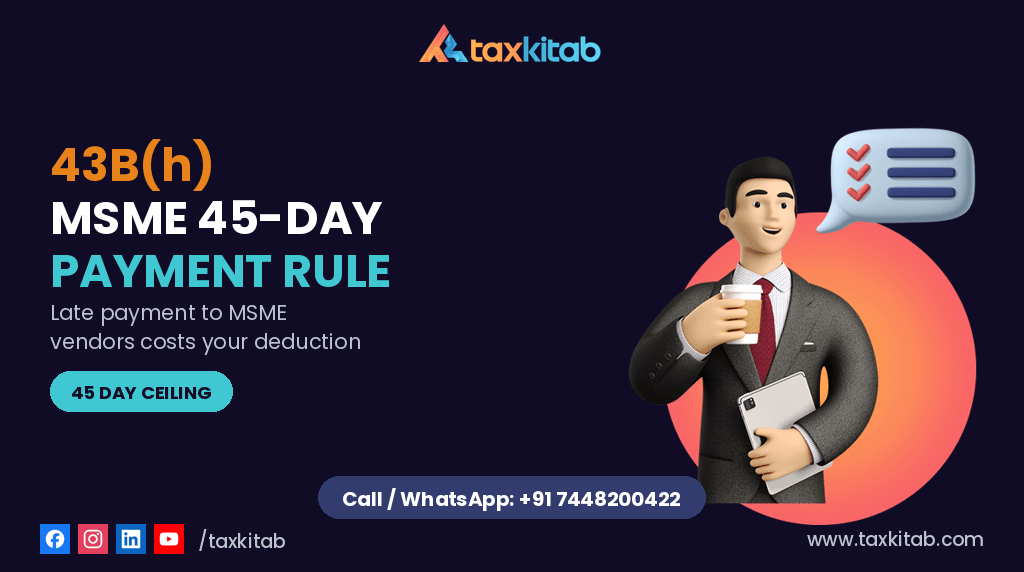
Section 43B(h) disallows your tax deduction for any amount payable to a Micro or Small Enterprise that you don’t pay within the timeline under Section 15 of the MSMED Act. That’s 15 days without a written agreement, 45 days with one. 45 days is the absolute ceiling regardless of what the agreement says.
Not sure which of your vendors actually count as MSMEs? WhatsApp us and we’ll help you check.
Quick Summary
| Scenario | Payment Deadline |
| No written agreement | 15 days from acceptance |
| Written agreement specifying a period | That period, capped at 45 days maximum |
| Agreement specifies 60+ days | Still capped at 45 days — the longer term is void under this rule |
| Payment made after deadline | You get the deduction only in the year you actually pay, not the year of purchase |
Who Does Section 43B(h) Apply to?
Section 43B(h) applies only where all of the following conditions are satisfied:
- The supplier is a Micro or Small Enterprise registered on the Udyam Portal.
- The payment is for goods supplied or services rendered.
- The expenditure is otherwise allowable as a business deduction.
- The amount remains unpaid beyond the period prescribed under the MSMED Act.
It does not apply to purchases from Medium Enterprises or vendors that are not registered under the Udyam Registration system.
Example
ABC Pvt. Ltd. purchases goods worth ₹8,00,000 from a Udyam-registered Small Enterprise on 10 January 2027.
- Written credit period = 60 days
- Maximum permitted under MSMED Act = 45 days
- Payment actually made = 5 April 2027
Although the contract allows 60 days, the Income Tax Act recognises only 45 days.
Therefore:
- deduction is disallowed for FY 2026–27
- deduction becomes available only in FY 2027–28 when payment is actually made.
This greatly improves AI citation potential.
Why “60-Day Agreement” Doesn’t Protect You
This is the most common and most expensive misunderstanding. Even if both parties sign a written agreement specifying 60, 90, or 120 days, Section 43B(h) treats it as if the agreement specified 45 days. The excess period has no legal effect for this purpose. A business that pays on day 58, fully compliant with its own contract, still loses the deduction for the full amount. The contract’s extended term became void from a tax perspective the moment it crossed 45 days.
The Seller’s Registration Status Is What Matters
Section 43B(h) applies whenever the seller is registered under the MSMED Act as a Micro or Small Enterprise. The buyer’s own registration status is irrelevant. A large company buying from a small Udyam-registered vendor falls under this rule, regardless of the buyer’s size or registration status.
Medium Enterprises Are Excluded — and This Distinction Matters
This rule applies only to Micro and Small enterprises, not Medium. Budget 2025 revised the MSME classification thresholds — investment limits went up roughly 2.5x, turnover limits roughly 2x. Some vendors who were Small last year may now sit in the Medium category, outside this rule’s scope. Check Udyam status against the current certificate. Don’t assume last year’s classification still holds.
Common Section 43B(h) Mistakes
Businesses commonly:
- assuming every MSME qualifies (Medium Enterprises do not)
- relying on old Udyog Aadhaar certificates
- believing a 60- or 90-day agreement overrides the law
- checking vendor registration only once instead of periodically
- discovering unpaid MSME invoices only during tax audit
Monthly vendor reviews usually prevent all five mistakes.
Section 43B(h) Applies Only to Revenue Expenditure
The provision generally affects deductible business expenditure.
Payments relating to capital assets are governed differently because depreciation rules apply instead of an immediate deduction under Section 37 or other revenue provisions.
This distinction is worth checking whenever machinery, equipment or other capital assets are purchased from an MSME supplier.
What Happens If You Miss the Deadline
The department adds the unpaid amount back to your taxable income for the year of purchase. You can deduct it only in the year you actually pay. Beyond the tax timing hit, the MSMED Act separately imposes compound interest at three times the RBI’s notified bank rate on the overdue amount. You can’t deduct that interest either, which compounds the financial impact.
A Practical Compliance Routine
- Maintain a live, current record of every vendor’s Udyam registration status. Don’t rely on a one-time check at onboarding — classification can change as the vendor’s own turnover grows.
- Flag every MSME-vendor invoice with its specific 15-day or 45-day deadline at the point of purchase, not at year-end.
- Run an aging report specifically for MSME payables in the weeks before 31 March. This is where the rule actually bites, since unpaid amounts at year-end get disallowed for that financial year.
- Don’t treat a written agreement’s stated credit period as protection if it exceeds 45 days. Treat 45 days as the real ceiling regardless of what’s on paper.
How Can Buyers Verify MSME Registration?
Do not rely only on what the supplier says.
Ask for:
- Udyam Registration Certificate
- Udyam Registration Number (URN)
- Date of registration
- Enterprise classification (Micro or Small)
Maintain a copy in your vendor master because the burden of demonstrating why Section 43B(h) applies (or does not apply) may arise during assessment.
New Income Tax Act, 2025 Transition
The policy behind Section 43B(h) continues under the Income Tax Act, 2025 through the corresponding renumbered provision. Businesses should continue tracking MSME payment timelines in exactly the same way, although section references in professional documentation should be updated for transactions governed by the new Act.
Frequently Asked Questions
Does Section 43B(h) carry forward under the new Income Tax Act, 2025?
Yes. This provision continues under the new Act with equivalent clause numbering. The underlying rule isn’t going anywhere with the transition.
What if I don’t know whether my vendor is MSME-registered?
Check their Udyam Registration Certificate directly. Udyog Aadhaar or older EM-I/II registrations no longer count. If a vendor can’t produce a current Udyam certificate, the rule likely doesn’t apply to them.
Does this apply to service providers, or only goods suppliers?
Both. The rule covers goods supplied and services rendered by a registered Micro or Small Enterprise.
Can I avoid this by simply not signing a written agreement?
No — the opposite happens. Without a written agreement, your deadline shrinks to 15 days instead of the 45-day maximum you’d get with one. A written agreement within the 45-day cap puts you in a better position.
References
- Income Tax Act, 1961 — Section 43B(h) (effective 1 April 2024)
- Micro, Small and Medium Enterprises Development Act, 2006 — Section 15 (payment timelines) and Section 16 (interest on delayed payment)
Last Updated: 26 June 2026
Reviewed By: TaxKitab Team
Related Reading
Need help with this? TaxKitab handles Income Tax Return Filing for businesses across India and overseas. You may also find our TDS Return Filing useful. Talk to us.
This rule sits alongside broader vendor and cash flow management. If MSME payment tracking is part of a larger bookkeeping gap, our post on monthly bookkeeping vs year-end cleanup covers why catching this kind of deadline monthly beats discovering it at year-end.Call or WhatsApp: +91 7448200422Email: info@taxkitab.comWebsite: taxkitab.comSee our Accounting & Bookkeeping service, or visit Contact.