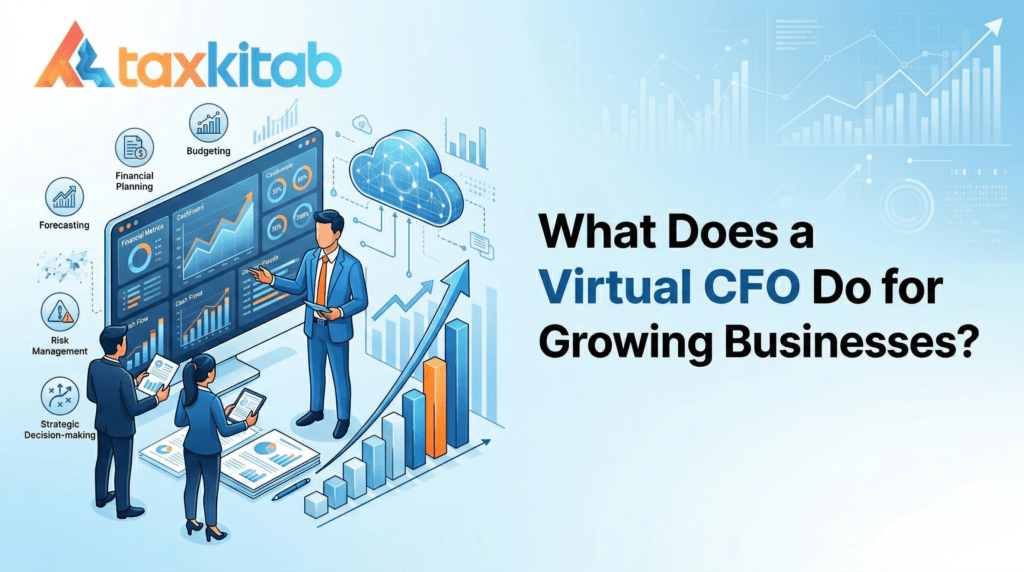
Many growing businesses struggle with financial clarity. Revenue increases, but actual profitability often remains unclear. Founders find themselves making major financial decisions on hiring, expansion, and investment without a structured framework to guide them.
So, what does a virtual CFO do that regular bookkeeping or accounting cannot? A Virtual CFO provides high-level financial direction, strategy, and guidance without the cost and commitment of a full-time hire.
In this guide, we explain the role of a Virtual CFO in detail. We also explore how virtual CFO services support business growth, improve financial decision-making, and bring structure to businesses navigating increasing financial complexity.
What Does a Virtual CFO Do?
A Virtual CFO is an experienced financial professional who provides CFO-level expertise to businesses on a part-time, remote, or project basis. They manage financial strategy, planning, and oversight without sitting in your office full-time.
A Virtual CFO typically handles:
- Financial planning and long-term strategy aligned with business goals
- Budgeting and forecasting to guide resource allocation and growth planning
- Cash flow management to ensure operational liquidity at all times
- Financial risk analysis and mitigation planning
- Financial reporting interpretation and business performance insights
- Compliance oversight and regulatory risk management
Unlike an accountant who focuses on recording and reporting, a Virtual CFO focuses on analyzing and advising. They translate financial data into strategic direction. As a result, business owners gain a trusted financial partner who helps them make smarter decisions at every stage of growth.
Key Responsibilities of a Virtual CFO
Understanding the virtual CFO roles and responsibilities in detail helps business owners see exactly where this function adds value. Here is a breakdown of the five core areas a Virtual CFO manages.
1. Financial Planning and Strategy
A Virtual CFO creates structured financial plans that align with the overall direction of the business. They start by understanding your business model, revenue streams, and growth goals. They then build financial roadmaps that define targets, set realistic milestones, and identify the resources required to get there.
Therefore, instead of reacting to financial challenges as they arise, businesses operate with a forward-looking plan that guides every major decision from investment and hiring to market expansion and product development.
2. Cash Flow Management
Cash flow problems are one of the most common reasons growing businesses stall or fail, even when they are profitable. A Virtual CFO tracks all inflows and outflows consistently, models future cash positions, and ensures the business always has sufficient liquidity to meet its obligations.
They also identify patterns such as seasonal dips or slow-paying customers and put strategies in place to manage them proactively. As a result, businesses avoid the sudden financial shortages that derail operations and damage supplier and employee relationships.
3. Budgeting and Forecasting
A Virtual CFO prepares detailed, realistic budgets based on actual business data not assumptions. They also build financial forecasts that project revenue, costs, and cash flow across future periods, giving business owners a clear picture of where the business is heading under different scenarios.
This helps businesses plan expansion confidently. Whether evaluating a new market, a major equipment purchase, or an additional hire, forecasting tools allow founders to model the financial impact before committing resources.
4. Financial Reporting and Insights
A Virtual CFO reviews financial reports regularly, including profit and loss statements, balance sheets, and cash flow statements. More importantly, they explain what those numbers mean in practical terms.
So, instead of receiving a monthly report you do not have time to fully interpret, you receive clear insights: which revenue streams are most profitable, which cost areas are growing faster than expected, and which financial metrics require immediate attention. This transforms financial reporting from a compliance task into a genuine management tool.
5. Risk Management and Compliance
A Virtual CFO identifies financial risks before they become problems. They assess exposure across areas such as credit risk, cash flow vulnerability, over-reliance on a single customer or revenue stream, and regulatory compliance gaps.
They also ensure the business stays compliant with applicable financial regulations, GST, TDS, income tax, and other statutory requirements. This reduces the likelihood of penalties, notices, and financial disruptions caused by compliance failures.
How a Virtual CFO Is Different from an Accountant
This is one of the most common points of confusion for business owners. Both roles are important, but they serve very different purposes.
| Accountant | Virtual CFO |
| Records daily transactions accurately | Analyzes financial data for strategic insights |
| Prepares financial reports and statements | Interprets reports and explains business impact |
| Manages tax filings and compliance | Identifies financial risks and manages exposure |
| Ensures regulatory obligations are met | Provides strategic financial direction and planning |
| Look at the future what should happen next | Look at the future, what should happen next |
Therefore, both roles complement each other. An accountant ensures your financial records are accurate and compliant. A Virtual CFO uses those records to provide strategic guidance that drives better decisions and stronger business outcomes.
Why Growing Businesses Need a Virtual CFO
Financial management for startups and growing SMEs involves a very different set of challenges compared to a stable, established enterprise. Growing businesses face:
- Complex financial decisions: Rapid growth brings decisions around investment, hiring, pricing, and funding that require financial expertise most founders do not have.
- Cash flow challenges: Growing businesses often experience cash flow gaps between earning revenue and actually receiving payment, a problem that requires proactive management.
- Expansion planning without financial clarity: Entering new markets, launching products, or scaling operations requires financial modelling and scenario planning that goes far beyond basic bookkeeping.
- Investor and lender readiness: Businesses seeking funding need clean financial records, credible projections, and a CFO-level narrative around their financial position.
A Virtual CFO provides the structure and clarity that removes financial confusion from the growth equation. As a result, founders can focus entirely on building the business rather than wrestling with financial decisions they are not equipped to make alone.
When Should You Consider Hiring a Virtual CFO?
Outsourced CFO services become most valuable at specific inflection points in business growth. Consider engaging a Virtual CFO when:
- Revenue is increasing, but profitability remains unclear: You are generating more income, but cannot easily explain where the money is going or why margins are not improving.
- Major financial decisions feel overwhelming: Decisions around expansion, hiring, pricing, or investment require financial expertise and modelling beyond what your current team can provide.
- Cash flow is becoming inconsistent: Your business regularly experiences cash shortages despite generating revenue, a clear signal that proactive cash flow management is needed.
- Business plans to raise funding: Investors and lenders require financial projections, clear reporting, and a credible CFO-level presence. A Virtual CFO prepares and supports this process.
- You cannot justify a full-time CFO yet: Your business needs CFO-level expertise, but is not yet at the scale where a full-time hire makes financial sense. A Virtual CFO bridges this gap cost-effectively.
Benefits of Hiring a Virtual CFO
Here is a clear summary of what a CFO for small businesses delivers in practical terms:
- Better financial decision-making: Every major business decision is backed by structured financial analysis and expert guidance not guesswork.
- Improved cash flow control: Proactive monitoring and forecasting eliminate cash flow surprises and ensure operational stability.
- Cost-effective compared to a full-time CFO: You access senior financial expertise at a fraction of the cost of a full-time hire, no salary, benefits, or long-term commitment required.
- Access to expert financial insights: Virtual CFOs bring experience across multiple industries and business stages, providing a perspective that internal generalists simply cannot match.
- Scalable financial support: Engagement scope adjusts as your business grows from focused support on a specific challenge to comprehensive ongoing financial management.
Conclusion
Understanding what a virtual CFO does helps growing businesses recognize the value of structured financial leadership. A Virtual CFO brings strategy, clarity, and control to businesses that are growing in complexity but are not yet at the scale of a large enterprise with a full finance team.
As revenue increases and financial decisions become more complex, expert guidance becomes essential, not optional. Therefore, having a Virtual CFO in your corner means making smarter decisions, avoiding costly mistakes, and scaling your business with genuine financial confidence.
With the right financial strategy and a trusted expert providing direction, businesses can grow with clarity and reduce the financial risks that derail so many promising companies.
Financial clarity drives business growth. Our Virtual CFO services help businesses manage finances strategically, improve cash flow control, and make better decisions at every stage of growth without the cost of a full-time hire.
Learn More About Our CFO Services
Frequently Asked Questions
A Virtual CFO manages financial strategy, cash flow planning, budgeting, and business performance analysis for small businesses. They provide CFO-level expertise on a flexible, part-time basis — giving small businesses access to senior financial guidance without the cost of a full-time hire. As a result, founders gain the financial clarity needed to make confident, informed decisions about growth.
For most growing businesses and SMEs, a Virtual CFO offers a more cost-effective solution than a full-time hire. You access the same level of financial expertise and strategic guidance at a fraction of the cost — with no salary, benefits, or long-term employment commitment. A full-time CFO becomes more appropriate as the business scales to the size where a dedicated, on-site financial leader is needed daily.
Yes, absolutely. Financial planning is a core role and responsibility of the virtual CFO. They create detailed budgets, build revenue and expense forecasts, and develop long-term financial strategies that align with your business goals. Therefore, instead of making expansion or investment decisions based on intuition, you have a structured financial plan that quantifies the opportunity, the risk, and the resources required.
An accountant focuses on recording transactions, preparing financial reports, and managing tax compliance. A Virtual CFO focuses on analyzing those reports, interpreting the financial data, and providing strategic guidance on how to improve performance and plan for growth. Both roles are important and complement each other — accurate accounting feeds the strategic work of the CFO.
Virtual CFO services are most valuable for growing SMEs, startups scaling quickly, businesses preparing for funding or investor conversations, and companies that are generating meaningful revenue but lack structured financial management. Also, businesses entering new markets, launching products, or making major operational investments benefit significantly from the financial modelling and strategic oversight a Virtual CFO provides.
A full-time CFO can cost significantly in salary, benefits, and bonuses — often making it financially unfeasible for early and mid-stage businesses. Virtual CFO services are typically priced on a monthly retainer or engagement basis, making them accessible to SMEs at a fraction of the full-time cost. Therefore, businesses gain senior-level financial expertise and strategic support without the overhead of a permanent executive hire.
Related Reading
• Outsourcing Accounting vs In-House: Which Is Better?
• How Proper Bookkeeping Helps in Tax Planning
Related Reading
- What Banks Actually Check Before Approving an SME Loan
- What a Virtual CFO’s Monthly MIS Report Actually Looks Like
- What Is Bookkeeping for Small Businesses? A Practical Guide for Growing Companies
Need help with this? TaxKitab handles Virtual CFO Services for businesses across India and overseas. You may also find our Accounting & Bookkeeping useful. Talk to us.
-
Pingback: How a Virtual CFO Improves Cash Flow Management
-
Pingback: Virtual CFO vs In-House CFO: Cost & Benefit Comparison for Growing Businesses - TaxKitab
-
Pingback: When Should a Startup Hire a Virtual CFO? Key Signs to Watch - TaxKitab
-
Pingback: Virtual CFO vs Accountant: Which One Does Your Business Need? - TaxKitab