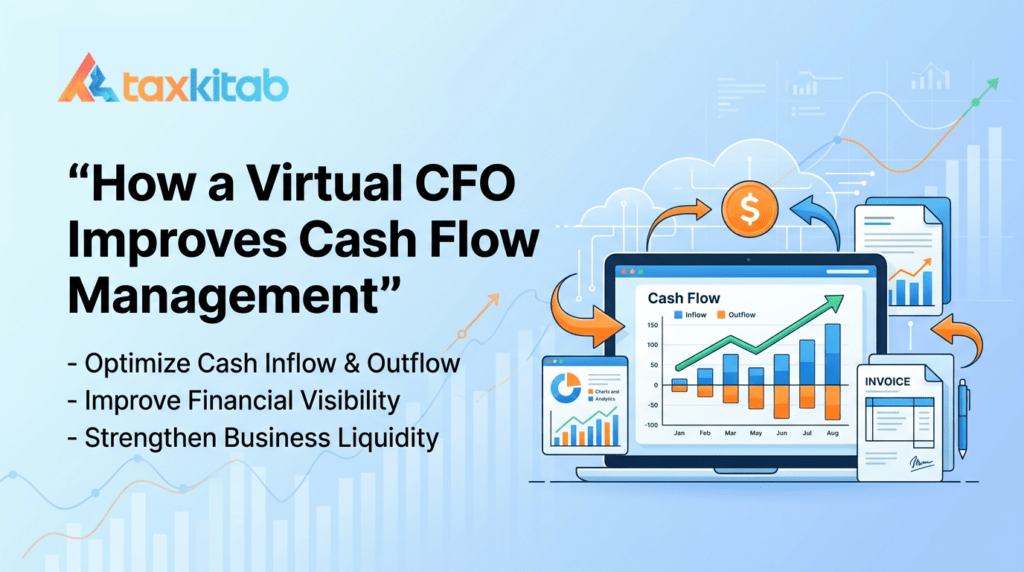
Many growing businesses generate consistent revenue yet still face unexpected cash shortages. Sales are coming in, but money seems to disappear before it can be put to work. This creates financial stress, delays critical payments, and limits a business’s ability to expand confidently.
Poor cash flow management is one of the leading causes of business instability at every stage of growth. Without structured financial oversight, businesses react to cash problems rather than preventing them.
Virtual CFO cash flow management offers a proactive solution. A Virtual CFO tracks, plans, and optimizes the movement of money through your business, ensuring financial stability, reducing risk, and giving founders the clarity they need to grow with confidence. In this guide, we explain exactly how this works and why it matters.
Cash flow forecasting is one part of our Virtual CFO service.
What Is Cash Flow Management?
Cash flow management is the process of tracking, analyzing, and optimizing the movement of money into and out of a business. It goes beyond simply knowing your bank balance; it involves understanding the timing of inflows and outflows, and actively managing them to maintain financial stability.
Effective cash flow management focuses on:
- Revenue inflows: When customer payments arrive, how consistently they come in, and which income streams deliver the most reliable cash
- Expense outflows: When operational costs, vendor payments, salaries, and tax obligations fall due
- Payment cycles: The timing gap between invoicing customers and actually receiving payment
- Liquidity planning: Ensuring enough cash is available at all times to meet short-term obligations without disrupting operations
Strong cash flow management ensures smooth daily operations. Therefore, businesses avoid the financial disruptions that arise when cash availability does not align with spending obligations.
Why Cash Flow Management Is Critical for Businesses
Cash flow is the operational heartbeat of every business. Even a highly profitable company can fail if cash is not available when it is needed. Here is why cash flow management for small businesses is so important:
- Supports daily operations: Rent, salaries, supplier payments, and utilities must be paid on time regardless of whether customers have settled their invoices.
- Helps pay employees and vendors on time: Late payments damage staff morale and supplier relationships, both of which are difficult and costly to repair.
- Enables growth planning: Expansion decisions, new hires, equipment, and market entry require cash reserves and accurate projections of future availability.
- Reduces financial stress: When founders know exactly what is coming in and going out, they can make decisions with confidence instead of anxiety.
Without proper cash flow management, businesses face operational instability and compounding financial pressure. As a result, growth slows, and strategic opportunities are missed.
How a Virtual CFO Improves Cash Flow Management
This is where virtual CFO services deliver their most immediate and visible impact. Here are the six ways a Virtual CFO strengthens cash flow management for growing businesses.
1. Creates Structured Cash Flow Planning
A Virtual CFO develops a clear, structured cash flow plan built around your specific business model. They map all expected inflows against scheduled outflows across weekly, monthly, and quarterly timeframes.
They also align this plan with your broader business goals, ensuring that growth investments, hiring decisions, and operational spending are timed in a way that maintains financial balance. As a result, businesses stop operating reactively and start managing cash flow with intention and structure.
2. Forecasts Future Cash Requirements
One of the most valuable contributions of virtual CFO cash flow management is forward-looking forecasting. A Virtual CFO prepares detailed cash flow projections modelling expected income and expenses across future periods based on historical data, seasonality, and business plans.
Therefore, businesses no longer discover cash shortages when they occur. They see them coming weeks or months in advance and can take corrective action before the situation becomes critical. Financial planning and forecasting of this quality is simply not possible without dedicated financial expertise.
3. Optimizes Receivables and Payables
The timing gap between issuing invoices and receiving payment is one of the most common sources of cash flow stress for SMEs. A Virtual CFO monitors your receivables aging report closely, identifying slow-paying customers, recommending follow-up processes, and suggesting invoice terms that improve collection speed.
On the payables side, they manage vendor payment schedules strategically, taking advantage of available payment terms without stretching beyond what the business can comfortably sustain. This dual optimization of what comes in and what goes out ensures consistent cash availability throughout the month.
4. Identifies Cash Flow Gaps Early
A Virtual CFO analyzes financial data regularly, not just at month-end. They review cash positions, payment patterns, revenue trends, and expense movements to identify potential gaps before they become disruptions.
As a result, businesses take corrective action early, whether that means accelerating collections, deferring a non-urgent expense, adjusting payment terms with a key vendor, or drawing on a credit facility. Early identification is everything in cash flow management. The same gap that is manageable with two weeks’ notice can become a crisis with two days.
5. Improves Expense Management and Cost Efficiency
Cash flow problems are not always caused by insufficient revenue. In many cases, they result from operational spending that grows faster than income. A Virtual CFO reviews business expenses in detail, examining every cost category to identify unnecessary spending, redundant subscriptions, and areas where cost efficiency can be improved.
This is one of the most direct cash flow strategies for SMEs, reducing outflows without compromising operational capability. Therefore, businesses improve their net cash position without necessarily needing to generate more revenue.
6. Provides Strategic Financial Insights for Better Decisions
Beyond the operational mechanics of cash flow, a Virtual CFO provides strategic financial insights that help business owners make smarter decisions. They explain financial trends in clear, practical terms, connecting what is happening in the numbers to what it means for the business.
This helps businesses improve business cash flow not just tactically, but strategically by making better decisions around pricing, payment terms, revenue mix, and growth timing. Data-driven guidance replaces financial guesswork at every level of the business.
Common Cash Flow Challenges Businesses Face
Understanding the root causes of cash flow problems helps businesses address them at the source. Here are the most common challenges that virtual CFO cash flow management is specifically designed to solve:
- Late customer payments: Long payment cycles and overdue invoices create gaps between when revenue is earned and when it is actually received, disrupting operational cash flow.
- High or uncontrolled operational expenses: Costs that grow faster than revenue steadily erode cash reserves without any single large expense triggering an alert.
- Poor or absent financial planning: Businesses without structured cash flow plans consistently face surprises, both positive and negative, that they are unprepared to manage.
- Lack of cash flow forecasting: Without forward-looking projections, businesses cannot anticipate upcoming obligations or plan resource allocation accurately.
- Irregular or seasonal revenue cycles: Businesses with uneven income patterns need careful management of cash reserves during lean periods to avoid disruption.
These challenges affect business stability and growth potential. Therefore, expert financial support becomes not just helpful but essential for businesses serious about scaling sustainably.
Benefits of Virtual CFO Cash Flow Management
Here is a clear summary of what businesses gain when they implement structured virtual CFO cash flow management:
| Benefit | What It Means for Your Business |
| Better liquidity control | Always know your cash position and have enough to meet every obligation on time |
| Reduced financial risks | Cash gaps, compliance issues, and payment defaults are identified and resolved before they escalate |
| Improved financial planning | Decisions on hiring, expansion, and investment are backed by accurate cash flow projections |
| Increased profitability | Cost efficiency improvements and better receivables management directly improve net cash position |
| Strong financial discipline | Structured processes replace reactive decision-making — giving the business a reliable financial foundation |
When Should You Consider a Virtual CFO for Cash Flow Management?
Professional cash flow guidance becomes most valuable when a business is experiencing specific financial pressure points. Consider engaging a Virtual CFO when:
- Cash flow feels unpredictable: You regularly experience surprises either running short unexpectedly or holding excess cash with no strategic plan for it.
- Business growth is accelerating: Rapid growth increases the complexity of cash flow significantly. More customers, more vendors, more payroll, and more compliance obligations all affect your cash position simultaneously.
- Financial planning lacks structure: You do not have a formal cash flow plan, forecast, or review process in place, meaning you are managing cash reactively rather than proactively.
- Expenses are rising without a clear cause: Operational costs are growing faster than revenue without a clear explanation, a signal that expense management needs professional attention.
- You are planning a significant investment: Before committing to a major hire, equipment purchase, or market expansion, you need accurate cash flow modelling to understand the financial impact.
Conclusion
Virtual CFO cash flow management helps businesses move from financial uncertainty to financial control. With structured planning, accurate forecasting, and proactive gap identification, businesses can maintain the liquidity they need to operate smoothly and grow with confidence.
As businesses grow, managing cash flow becomes more complex. Therefore, expert financial guidance becomes increasingly valuable not as a luxury, but as a strategic necessity. A Virtual CFO provides the clarity, structure, and direction that transforms cash flow management from a constant source of stress into a genuine competitive advantage.
With the right financial strategy in place, businesses can scale sustainably, plan with confidence, and make every financial decision from a position of clarity and control.
Strong cash flow management supports sustainable business growth. Our Virtual CFO services help businesses plan finances strategically, manage cash flow proactively, and make better decisions at every stage of growth so you are always one step ahead of your numbers.
Frequently Asked Questions
A Virtual CFO improves cash flow management by creating structured cash flow plans, building accurate forecasts, optimizing receivables and payables, identifying gaps early, and reviewing expenses for efficiency. They provide proactive, forward-looking financial oversight that prevents cash problems rather than simply responding to them. As a result, businesses maintain consistent liquidity and operational stability throughout the year.
For SMEs, cash flow is the difference between operational stability and disruption. Even profitable businesses can fail if they run out of cash to meet immediate obligations. Effective cash flow management ensures businesses can pay employees and vendors on time, plan growth investments, and navigate periods of irregular income without compromising operations or relationships.
Yes. A Virtual CFO starts by diagnosing the root causes of existing cash flow issues — whether that is slow receivables, uncontrolled expenses, poor forecasting, or structural gaps in the business model. They then create a structured plan to address each issue, implement better processes, and build forward-looking financial management that prevents the same problems from recurring.
Cash flow management focuses specifically on the timing and availability of cash — ensuring the business has enough money to meet its obligations at every point in time. Financial planning is broader — it covers overall business strategy, budgeting, investment decisions, and long-term financial goals. A Virtual CFO handles both, using cash flow management as a core component of the wider financial planning process.
The timeline depends on the complexity of the business and the severity of existing cash flow challenges. However, many businesses see immediate improvements in visibility and planning within the first month of engagement — simply from having a structured cash flow review and forecast in place. Structural improvements to receivables, payables, and expense management typically deliver measurable results within the first quarter.
Absolutely. Startups face particularly acute cash flow challenges — irregular revenue, high initial expenses, and unpredictable growth patterns. Virtual CFO services are well-suited to startups because they provide expert financial management without the cost of a full-time hire. Therefore, early-stage businesses can build strong financial foundations from the beginning, avoiding the cash flow problems that derail many promising startups before they reach their potential.
Related Reading
• What Does a Virtual CFO Do for Growing Businesses?
• Essential Financial Reports Every SME Must Track
• Outsourcing Accounting vs In-House: Which Is Better?
Related Reading
- Financial Planning for Startups
- Virtual CFO vs In-House CFO
- How Proper Bookkeeping Helps in Tax Planning for Growing Businesses
Need help with this? TaxKitab handles Virtual CFO Services for businesses across India and overseas. You may also find our TaxKitab Books useful. Talk to us.
-
Pingback: Virtual CFO vs In-House CFO: Cost & Benefit Comparison
-
Pingback: Virtual CFO vs Accountant: Which One Do You Need?