Growing businesses often reach a stage where financial decisions become too complex to manage without senior financial leadership. Revenue has scaled, compliance obligations have grown, and strategic decisions demand CFO-level thinking. At this point, founders face a critical question: should they hire an in-house CFO or engage a Virtual CFO?
Both options offer genuine financial expertise, but they differ significantly in cost, flexibility, scalability, and the kind of value they deliver. The choice between a virtual CFO vs an in-house CFO is not simply a cost decision. It is a strategic one that depends on where your business is today and where it is heading.
In this guide, we compare both models across every dimension that matters so you can make an informed, confident decision for your business.
Our own Virtual CFO engagement runs on a monthly MIS pack and a review call.
What Is an In-House CFO?
An in-house CFO is a full-time executive employee who works exclusively for your organisation. They are physically present in the business, embedded in its operations, and responsible for all aspects of financial leadership on a day-to-day basis.
An in-house CFO typically handles:
- Financial strategy development and long-term planning aligned with business objectives
- Budgeting, forecasting, and performance monitoring across all business units
- Financial reporting, compliance oversight, and regulatory management
- Internal finance team coordination and leadership
- Board-level financial communication and investor relations
An in-house CFO provides dedicated, full-time financial leadership. However, this model comes with the full cost and commitment of a senior executive hire, which is a significant financial undertaking for many businesses.
What Is a Virtual CFO?
A Virtual CFO provides CFO-level financial expertise on a remote, flexible, or part-time basis. Rather than joining as a full-time employee, they work under a service engagement delivering the same strategic financial guidance as an in-house CFO, without the overhead of a permanent hire.
Virtual CFO services typically cover:
- Financial planning and long-term strategy aligned with business goals
- Cash flow management, forecasting, and liquidity planning
- Financial reporting, performance analysis, and business insights
- Strategic guidance on investment, expansion, and financial risk
- Compliance oversight for GST, TDS, and income tax obligations
Virtual CFO services offer flexibility without full-time hiring. Therefore, businesses access senior financial expertise at a fraction of the cost, scaling the engagement up or down as needs evolve.
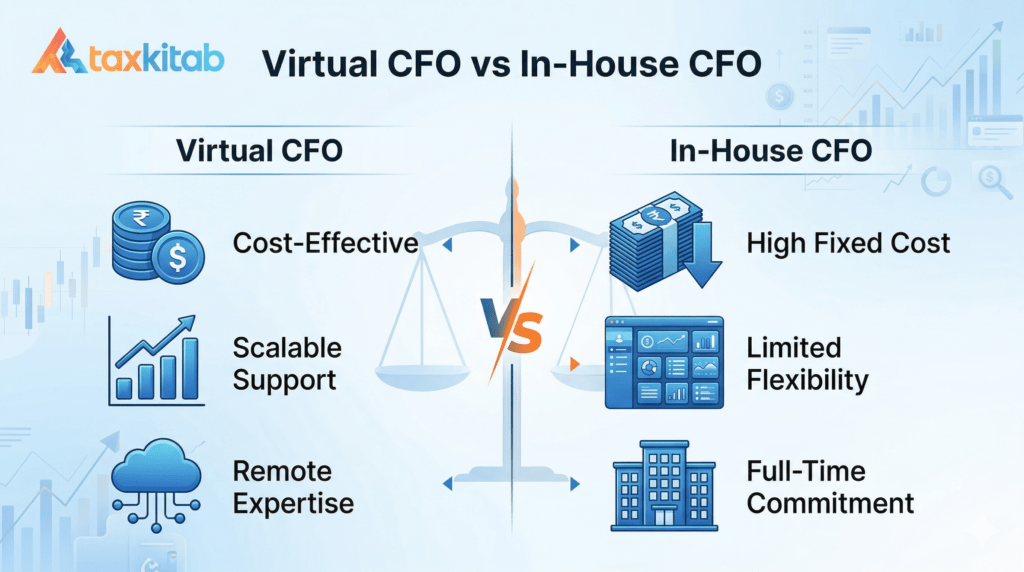
Virtual CFO vs In-House CFO: Key Differences
Here is a detailed comparison across the five dimensions that matter most when choosing between these two models.
| Factor | In-House CFO | Virtual CFO |
| Cost | High salary + benefits + infrastructure | Flexible service fee — no employee overhead |
| Expertise | Deep knowledge of one business | Broad cross-industry experience and insights |
| Scalability | Fixed role — hard to scale quickly | Flexible — easily scales with business growth |
| Flexibility | Fixed hours, defined responsibilities | On-demand support, customizable scope |
| Accessibility | Physically present — immediate access | Structured digital communication and reporting |
| Best For | Large enterprises with complex operations | Growing SMEs, startups, cost-conscious businesses |
1. Cost Comparison
This is the most significant difference between the two models. An in-house CFO commands a senior executive salary, along with provident fund contributions, health benefits, performance bonuses, annual increments, and the infrastructure costs of supporting a C-suite employee. The total annual cost is substantial, and it is fixed regardless of whether the business has a quiet month or a complex one.
A Virtual CFO operates on a transparent, flexible service fee. You pay for the scope of work you need, whether that is a focused engagement on a specific challenge or comprehensive ongoing financial management. Therefore, a Virtual CFO suits budget-conscious businesses that need CFO-level expertise without committing to a full executive salary.
2. Expertise and Industry Exposure
An in-house CFO develops deep, contextual knowledge of one business over time. They understand the company’s culture, history, and operational nuances, which is genuinely valuable in large, complex organisations.
A Virtual CFO, however, typically works across multiple businesses and industries simultaneously. This gives them a breadth of perspective that no single in-house CFO can match. As a result, businesses gain access to diverse industry insights, best practices from multiple sectors, and exposure to financial strategies that would not be visible to someone working exclusively within one company.
3. Scalability
An in-house CFO is a fixed role. Scaling their responsibilities as the business grows is limited by the structure of their employment, and if more CFO-level capacity is eventually needed, another senior hire is required — with all the associated time and cost.
A Virtual CFO engagement scales with a conversation. As your business grows, transaction volumes increase, or compliance complexity expands, the scope of outsourced CFO benefits can be adjusted quickly and without the friction of a new hiring process. Therefore, a Virtual CFO supports growing businesses more flexibly and efficiently than a fixed internal role.
4. Flexibility and Service Scope
An in-house CFO operates within fixed working hours and a defined set of responsibilities. Their role is structured around the organisation’s needs at the time of hiring, which can be difficult to adjust as those needs change.
Virtual CFO services offer on-demand support with a customizable scope. Businesses can engage for specific projects such as fundraising preparation, financial restructuring, or cash flow crisis management or on an ongoing basis for comprehensive financial management. This flexibility improves operational efficiency and ensures you are always paying for exactly what your business needs.
5. Control and Accessibility
The primary advantage of an in-house CFO is physical presence, immediate access, real-time coordination, and deep daily integration with the business. For large organisations with multiple departments and complex operational coordination requirements, this is genuinely valuable.
A Virtual CFO operates through structured digital communication, scheduled reporting cycles, regular strategy calls, and cloud-based financial platforms. For most growing businesses, this model provides all the financial oversight and accessibility they need. However, for businesses that require constant, immediate CFO presence throughout the working day, an in-house model may be more appropriate.
When Should You Choose an In-House CFO?
An in-house CFO is the right choice in specific contexts. For credibility and completeness, here is when the in-house model genuinely makes sense:
- Large enterprise structure: Organisations with substantial finance teams require a dedicated, embedded executive to lead and coordinate the internal financial function day to day.
- Complex daily financial operations: Businesses processing high volumes of multi-currency, multi-entity, or multi-location transactions may require constant on-site CFO supervision.
- Board-level daily financial leadership: Companies with active boards, investor reporting obligations, or frequent M&A activity may need a full-time CFO as a permanent presence at the executive table.
- Large established finance department: If your business already has a team of accountants, analysts, and finance managers requiring senior leadership, an in-house CFO is the natural choice.
When Is a Virtual CFO the Better Choice?
For the majority of growing businesses, a Virtual CFO delivers superior value at the right cost. Consider this model when:
- You are a growing SME or startup: Access CFO-level financial expertise without the cost and commitment of a full-time executive hire.
- You are scaling operations rapidly: Virtual CFO services scale alongside your business, with no hiring delays or fixed role constraints to limit your growth.
- You need to manage costs strategically: CFO services for small businesses on a flexible fee model convert a high fixed cost into a predictable, scalable investment.
- You need expert guidance without daily supervision: If your financial needs require strategic oversight, planning, and reporting rather than constant daily coordination, a Virtual CFO delivers everything you need.
- You are expanding into new markets or seeking funding: A Virtual CFO prepares financial models, investor narratives, and compliance frameworks that make your business investor and lender-ready.
Common Mistakes Businesses Make While Choosing
Making this decision poorly can be costly. Here are the most common mistakes businesses make when choosing between virtual CFO vs in-house CFO models:
- Choosing based only on cost: The cheapest option is rarely the best one. The real question is which model delivers the right expertise and outcomes for your business stage.
- Ignoring long-term scalability: An in-house CFO hired for your current size may not serve your business well eighteen months from now. Always plan for where the business is going, not just where it is today.
- Underestimating financial complexity: Businesses that delay hiring any CFO-level support often discover that financial complexity has already compounded beyond what can be quickly corrected.
- Hiring too early or too late: Hiring a full-time CFO before the business can sustain the cost is a drain on resources. Waiting too long to engage any CFO support means making complex financial decisions without the expertise to make them well.
How to Decide What Is Right for Your Business
Use this practical framework to evaluate which model suits your business today and in the next phase of growth.
- What is your business size and structure? If you are a growing SME or startup, a Virtual CFO almost certainly delivers better value. If you are a large enterprise with a dedicated finance team, an in-house CFO may be the natural next step.
- Do you need a full-time, daily CFO presence? If your financial operations require constant, on-site coordination throughout the working day, in-house may be appropriate. If structured reporting and periodic strategy sessions meet your needs, a Virtual CFO is the better fit.
- Can you sustain long-term payroll commitment? Calculate the full cost of an in-house CFO salary, benefits, bonuses, and infrastructure and assess whether the business can comfortably sustain this indefinitely.
- Is flexibility important for your current stage? Businesses going through rapid change, scaling, pivoting, or restructuring benefit greatly from the flexibility of virtual CFO services over a fixed internal role.
- Are financial decisions becoming increasingly complex? If financial decisions now require senior-level expertise and strategic guidance, it is time to engage CFO-level support, and for most businesses at this stage, a Virtual CFO is the most logical entry point.
Conclusion
The choice between a virtual CFO vs an in-house CFO is not a question of which model is universally superior. It is a question of which model is right for your business stage, your budget, and your long-term goals.
In-house CFOs provide dedicated, embedded financial leadership for large organisations with complex, high-volume operations. However, Virtual CFOs offer the flexibility, cost efficiency, and breadth of expertise that make them the strategically stronger choice for the vast majority of growing businesses.
Therefore, evaluating your current financial needs and future growth plans honestly using the framework in this guide will help you choose the right financial leadership model. The right choice at the right stage can significantly improve financial stability, decision quality, and long-term business growth.
Choosing the right CFO model can significantly impact your financial strategy, compliance readiness, and business growth. Our Virtual CFO services help growing businesses manage finances strategically, improve decision-making, and scale efficiently without the cost and commitment of a full-time executive hire.
Frequently Asked Questions
An in-house CFO is a full-time executive employee who works exclusively within your organisation, physically present day to day. A Virtual CFO provides the same CFO-level financial expertise remotely, on a flexible service-based model. The core difference is cost, flexibility, and scalability. A Virtual CFO delivers senior financial leadership without the full-time employment commitment and overhead.
Yes, for most growing businesses. An in-house CFO carries the full cost of a senior executive hire salary, benefits, provident fund, bonuses, and infrastructure. A Virtual CFO operates on a transparent monthly service fee with no employee overhead. Therefore, businesses access the same level of financial expertise at significantly lower cost, making it the more cost-effective option for SMEs and growing companies.
A Virtual CFO is almost always the better choice for startups and early-stage businesses. It provides access to CFO-level financial strategy, cash flow management, and compliance oversight without the cost of a full-time hire. The flexibility of the engagement also suits the fast-changing nature of startup operations, allowing the scope of support to scale as the business grows.
Yes. Virtual CFO services regularly include fundraising preparation, financial modelling, investor reporting, and the development of financial narratives for board presentations. An experienced Virtual CFO brings the credibility and expertise to support investor conversations and due diligence processes effectively, often bringing insights from working with multiple funded businesses across different sectors.
Your business is ready for CFO-level support when financial decisions are becoming complex enough to require strategic expertise not just accounting. Key signals include: revenue growth accompanied by unclear profitability, inconsistent cash flow despite good sales, increasing compliance requirements, plans to raise funding, or major investment decisions that need financial modelling. At this stage, a Virtual CFO is typically the most practical and cost-effective entry point.
This is a natural and well-managed transition for businesses that reach enterprise scale. A Virtual CFO engagement can continue until the business genuinely needs full-time, on-site financial leadership. At that point, the Virtual CFO can actively support the search, handover, and onboarding of an in-house CFO — ensuring financial continuity and a smooth transition of institutional knowledge.
Related Reading
What Does a Virtual CFO Do for Growing Businesses?
How a Virtual CFO Improves Cash Flow Management?
Outsourcing Accounting vs In-House: Which Is Better?
We also keep the books for businesses outside India under Outsourced Accounting, working inside your own accounting software rather than moving your data to ours.
Related Reading
- Essential Financial Reports Every SME Must Track for Better Financial Control
- When Should a Startup Hire a Virtual CFO? Key Signs to Watch
- 6 Inaccurate Bookkeeping Signs You Should Never Ignore (And Why It Matters)
Need help with this? TaxKitab handles Virtual CFO Services for businesses across India and overseas. You may also find our Compliance Calendar useful. Talk to us.