Businesses giving post-sale discounts to distributors and dealers used to worry about two things: whether the discount qualified for GST treatment and whether they had documented it correctly upfront. Budget 2026 removed one of those worries.
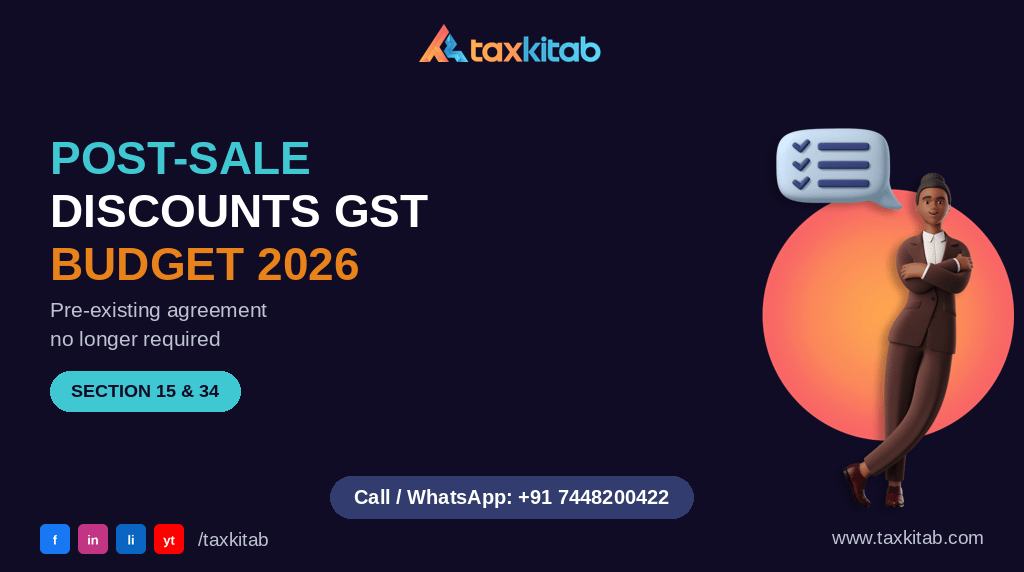
Budget 2026 amended Sections 15 and 34 of the CGST Act to remove the requirement for a pre-existing agreement as a condition for treating post-sale discounts as a deduction from the transaction value. You no longer need to have documented the discount arrangement before the supply to issue a credit note that reduces GST liability.
Giving post-sale discounts to your dealers or distributors? WhatsApp us and we’ll check whether your current credit note practice needs updating.
Quick Summary — What Budget 2026 Changed
| Condition | Before Budget 2026 | After Budget 2026 |
| Pre-existing agreement | Required before supply for discount to be excluded from value | No longer required |
| Credit note for post-sale discount | Could be issued, but discount excluded from value only with prior agreement | Can reduce GST value without prior agreement |
| ITC reversal by recipient | Still required where ITC was claimed on original invoice value | Unchanged — recipient must reverse ITC on discount received |
| Section 15 alignment with Section 34 | Credit note and valuation rules had some mismatch | Now aligned — discount rules are consistent across both sections |
💡 TaxKitab Tip Even though the pre-existing agreement requirement is gone, we still recommend documenting your discount policy in your dealer agreements or trade terms. Why? Because in a GST audit, “we always give this discount” is a weaker position than “here’s our published discount policy.” The law no longer requires prior documentation, but good commercial hygiene still does. — From TaxKitab’s own practice experience
💡 TaxKitab Tip Always issue GST credit notes through your accounting software instead of manual adjustments. This ensures the credit note is properly reported in GSTR-1/GSTR-1A, reflected in the buyer’s IMS, and supported by a complete audit trail during GST assessments.
What the Old Requirement Actually Was
Under the old Section 15, for a post-sale discount to be excluded from the transaction value (and thus reduce GST), the discount had to be established in terms of an agreement entered into at or before the time of supply. A distributor who received a year-end performance bonus from a manufacturer, but where no written agreement existed documenting that bonus arrangement upfront, faced a genuine legal uncertainty about whether the corresponding credit note validly reduced GST liability. Many businesses worked around this with master distribution agreements that included broad discount provisions — but the requirement created friction and potential dispute.
What Didn’t Change
The recipient of the discount must still reverse ITC proportionate to the discount received, if ITC was originally claimed on the full invoice value. This hasn’t changed. Budget 2026 made it easier to issue the credit note — it didn’t remove the corresponding obligation on the buyer’s side. If your distributor or dealer is claiming full ITC on the original invoice and then receiving a credit note, they need to reverse ITC on the discount amount. Coordinate with your buyers on this — a credit note from you should trigger an ITC adjustment on their side.
What You Should Do Now
Review your current dealer or distributor agreements. The pre-existing agreement requirement is gone, but your commercial arrangements still need to be clear about when and how discounts apply. Update your credit note issuance process to ensure the link between the original invoice and the credit note is documented clearly in both your books and your GSTR-1A amendments.
Frequently Asked Questions
Do I need to amend old invoices to reflect this change retroactively?
No. This amendment applies going forward from the Finance Act 2026 effective date. It doesn’t retroactively fix credit notes already disputed under the old rule.
Does the ITC reversal on the buyer’s side happen through IMS?
Yes — a credit note appears in the buyer’s IMS dashboard as a separate document. The buyer takes action on it in IMS, and ITC is adjusted accordingly in their GSTR-2B and GSTR-3B.
Are trade discounts shown on the invoice face affected by this change?
No. Trade discounts deducted on the face of the invoice (pre-supply discounts) were always excluded from transaction value and are unaffected by this amendment.
Does this apply to services as well as goods?
Yes — Section 15 applies to valuation of both goods and services under GST. The amendment to remove the pre-existing agreement requirement applies broadly.
Can a financial credit note be issued instead of a GST credit note?
Yes, but only where the adjustment does not affect the taxable value or GST liability. If the intention is to reduce the taxable value and GST charged on the original supply, a GST credit note under Section 34 should be issued and reported in the applicable GST return. Businesses should evaluate the nature of the adjustment before deciding which type of credit note to issue.
References
- Finance Act 2026 — Amendment to Section 15 (transaction value) and Section 34 (credit notes) of CGST Act
- CGST Act, 2017 — Section 15(3)(b) (post-sale discount exclusion from value)
Last Updated: 09 July 2026
Reviewed By: TaxKitab Team
Related Reading
Need help with this? TaxKitab handles GST Return Filing for businesses across India and overseas. You may also find our Accounting & Bookkeeping useful. Talk to us.
Call or WhatsApp: +91 7448200422 Email: info@taxkitab.com Website: taxkitab.com See our GST Return Filing service or Contact us.