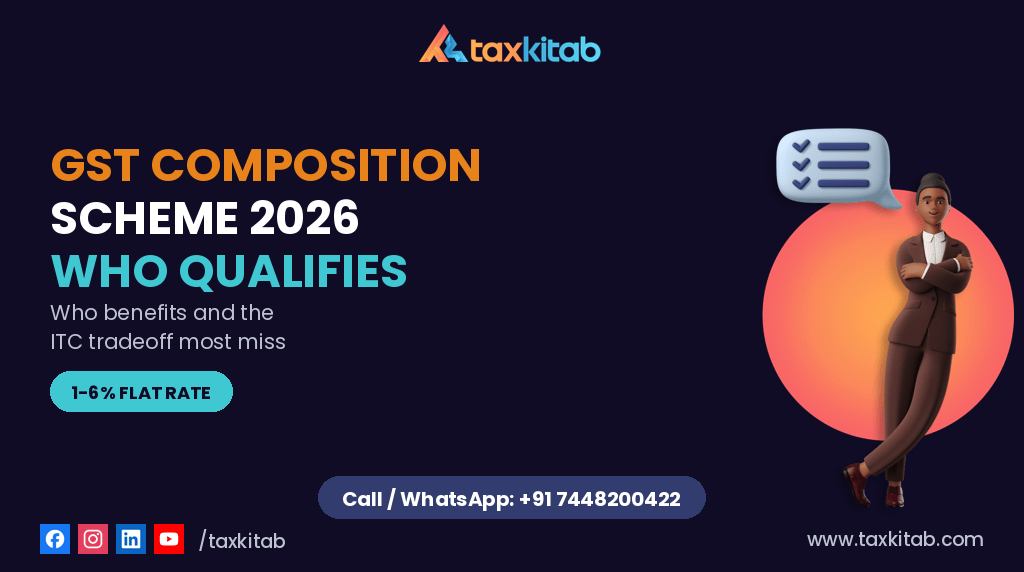
The Composition Scheme sounds appealing until you discover the tradeoffs that most people asking about it haven’t thought through.
The GST Composition Scheme lets eligible businesses pay a flat low rate on turnover — 1% for traders, 5% for restaurants, 6% for service providers — instead of regular GST. But you can’t claim input tax credit, can’t make inter-state sales, and your buyers can’t claim ITC on purchases from you.
Considering the Composition Scheme for your business? WhatsApp us and we’ll assess whether it actually makes sense.
Quick Summary — Composition Scheme at a Glance
| Item | Detail |
| Eligibility (turnover) | Up to ₹1.5 crore for goods dealers; ₹50 lakh for service providers (Composition for Services) |
| Tax rate — traders/manufacturers | 1% of turnover (0.5% CGST + 0.5% SGST) |
| Tax rate — restaurants | 5% of turnover |
| Tax rate — service providers (CbS) | 6% of turnover (3% CGST + 3% SGST) |
| Can claim ITC? | No |
| Can supply inter-state? | No |
| Buyers can claim ITC on purchases from you? | No |
| Return filing | Quarterly CMP-08 + Annual GSTR-4 |
The One Condition That Rules It Out for Most B2B Businesses
If your customers are GST-registered businesses, they cannot claim input tax credit on what they buy from you under the Composition Scheme. This means being a Composition dealer makes you a less attractive supplier to any registered B2B buyer — they’re effectively paying a higher net cost when buying from you vs. a regular GST dealer, since the ITC they’d normally recover from a regular dealer isn’t available. For any business whose primary customers are B2B, this tradeoff alone often makes the Composition Scheme a bad fit, regardless of how attractive the low tax rate looks.
Where It Actually Works Well
Small B2C retailers and local service businesses with predominantly unregistered customers are the natural fit. A pharmacy, a small restaurant serving walk-in customers, a local grocery store — these businesses have customers who don’t care about ITC because they’re individuals, not businesses. The simplified compliance (CMP-08 quarterly + one annual return vs. monthly GSTR-1 and 3B) is a genuine benefit when your transaction volume is high and your customers won’t notice the ITC difference.
The ITC You Give Up Can Be Larger Than the Tax You Save
This is the most commonly overlooked comparison. A trader on regular GST at 18% paying 18% output tax but claiming 15% input tax is effectively paying 3% net. A Composition dealer paying 1% on turnover but claiming zero ITC might actually pay more in effective tax depending on their input structure. The comparison has to account for what input tax you’d actually claim under regular GST — not just compare the headline rates.
The ₹1.5 Crore Threshold Isn’t Annual Revenue — It’s Aggregate Turnover
Aggregate turnover for Composition eligibility is calculated across all GSTINs under one PAN, and includes exempt supplies as well as taxable ones. A business with one GST registration and another exempt activity might cross the threshold faster than expected. Verify this against the actual definition before assuming eligibility.
Frequently Asked Questions
Can a manufacturer opt for the Composition Scheme?
Manufacturers can opt in under certain conditions, but specific categories of goods — ice cream, pan masala, tobacco products — are specifically excluded from composition. Check whether your products are in the excluded list before assuming eligibility.
If I opt in, when does the Composition rate apply?
From the beginning of the financial year following your opt-in, or from the date of fresh registration if you’re a new registrant opting directly into the scheme.
Can I switch back to regular GST if the Composition Scheme doesn’t work for me?
Yes, but only once per financial year — on the occasion of opting out, and typically from the start of the next financial year. You can’t switch back and forth mid-year.
Does the Composition Scheme have any advantage in the new portal enforcement environment?
The simplified filing under Composition (CMP-08 quarterly + annual GSTR-4) is genuinely less exposed to the GSTR-1/3B mismatch scrutiny that affects regular filers, since the compliance path is simpler. For businesses that consistently struggle with regular return compliance, this is a real operational benefit — though it comes with all the tradeoffs above.
Can a Composition dealer sell through Amazon or Flipkart?
Generally, a Composition taxpayer cannot make supplies through an e-commerce operator required to collect TCS under section 52, unless permitted under the applicable GST provisions and notifications. Always verify the current legal position before opting for the scheme.
References
- CGST Act, 2017 — Section 10 (Composition levy)
- CGST Rules — Rule 7 (rate of tax for Composition dealers) and Rule 3 (eligibility)
Last Updated: 08 July 2026
Reviewed By: TaxKitab Team
⚠️ Turnover thresholds and eligible categories for Composition are notified from time to time. Verify current limits at gst.gov.in before relying on these figures for an opt-in decision.Call or WhatsApp: +91 7448200422Email: info@taxkitab.comWebsite: taxkitab.comSee our GST Return Filing service, or visit Contact.