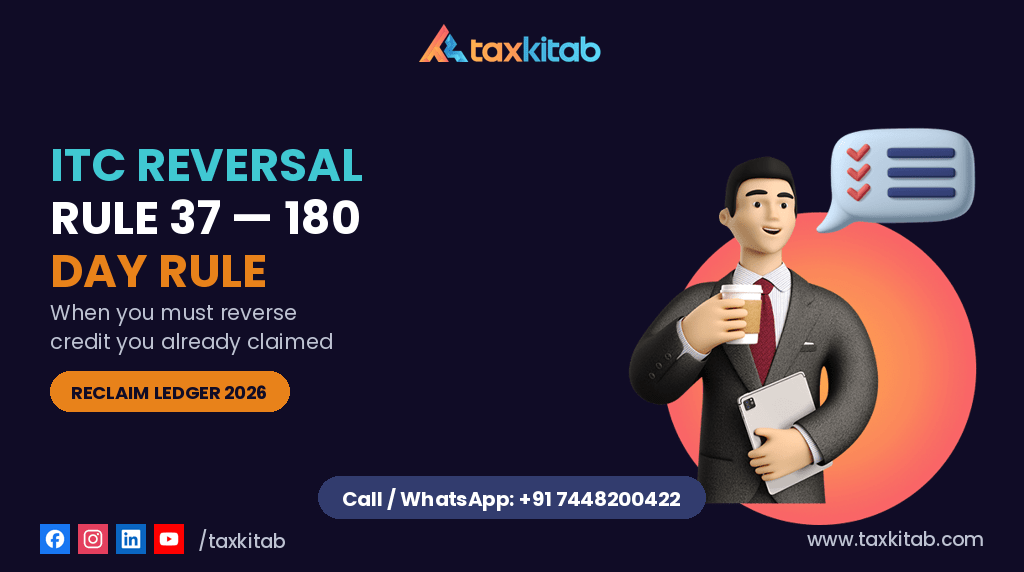
A business can claim ITC the moment an invoice lands in their GSTR-2B. That credit is provisional, not permanent — and Rule 37 is the mechanism that takes it back if a supplier doesn’t get paid in time.
Rule 37 requires you to reverse Input Tax Credit if you haven’t paid your supplier — the invoice value plus GST — within 180 days of the invoice date. The reversal happens in the GSTR-3B for the month following the 180-day expiry, with 18% annual interest on the reversed amount.
Tracking unpaid invoices approaching the 180-day mark? WhatsApp us and we’ll help you get ahead of it.
How the Mechanics Actually Work
You claim ITC normally when an invoice reflects in your GSTR-2B. The 180-day clock starts from the invoice date, not from when you claimed the credit. If payment — including the GST portion — isn’t made by day 180, you must add the ITC back to your output tax liability in the GSTR-3B for the period in which day 181 falls. Interest under Section 50 runs from the date you originally claimed the credit to the date of reversal, at 18% per annum.
Partial Payment Gets Proportionate Treatment
If you’ve paid part of an invoice by day 180, you only reverse the ITC corresponding to the unpaid portion, not the entire claimed amount. For example, on a ₹1,80,000 ITC claim where 60% has been paid by day 180, you’d reverse ITC proportionate to the remaining 40% — roughly ₹72,000 — rather than the full amount.
Re-Claiming Is Allowed, With No Time Limit
Once you eventually pay the supplier — even years later — you can re-claim the reversed ITC in the GSTR-3B for the period of payment. Unlike the standard Section 16(4) deadline that bars claiming ITC after a certain point, re-claims under Rule 37 carry no time limit. The only permanent loss is the interest already paid during the reversal period — that doesn’t get refunded when you re-claim.
Rule 37A Is a Separate, Parallel Track
Don’t confuse Rule 37 with Rule 37A. Rule 37 is about your payment to the supplier. Rule 37A triggers when the supplier hasn’t filed their own GSTR-3B or paid the tax to the government, regardless of whether you’ve paid them. Under Rule 37A, you must reverse ITC by 30 November following the relevant financial year if the supplier’s non-filing persists by 30 September of that year — re-claimable once the supplier eventually files and pays.
The 2026 Portal Change That Makes This Harder to Ignore
From January 2026, the GST portal fully operationalized a Reclaim Ledger that tracks every reversal and re-claim against each other. The system now auto-alerts and can block your GSTR-3B filing entirely if your claimed re-credit doesn’t match your tracked reversal history. Businesses that previously handled Rule 37 loosely, planning to “sort it out at audit,” no longer have that flexibility — the portal enforces the matching in real time.
What Doesn’t Trigger Rule 37
Reverse charge supplies are explicitly excluded from this rule, since the tax mechanics work differently there. Imports of goods are also excluded, since IGST on imports is paid directly to Customs rather than to a domestic supplier.
TaxKitab Tip: Review all unpaid vendor invoices every month. Waiting until the annual audit often results in avoidable Rule 37 reversals and interest costs.
Frequently Asked Questions
Does Rule 37 apply if I’ve paid the supplier but not yet paid the GST portion separately?
The rule requires payment of the full invoice value including the tax component — paying only the base value without the GST portion doesn’t satisfy the 180-day requirement.
What if my supplier goes into insolvency before I can pay them?
This is a genuinely unresolved grey area with no official CBIC clarification as of this writing — document the situation carefully and seek specific guidance, since the standard reversal mechanics may not cleanly apply.
Can I avoid Rule 37 entirely by negotiating longer payment terms with suppliers?
No — longer payment terms just mean you’ll likely hit the 180-day reversal point before paying, since the rule is tied to the invoice date, not your contractual payment terms. Longer terms increase your reversal risk rather than avoiding it.
Does multi-GSTIN ISD registration affect Rule 37 exposure?
Yes, indirectly — since Input Service Distributor registration became mandatory from April 2025 for businesses with multiple GSTINs under one PAN, unpaid invoices at the head office level can create reversal exposure across every branch that received a portion of that distributed credit.
References
- CGST Act, 2017 — Section 16(2), second proviso
- CGST Rules — Rule 37 (as amended by Notification No. 26/2022-Central Tax) and Rule 37A
- CBIC Circular No. 186/18/2022-GST (interest applicability clarification)
Last Updated: 08 July 2026
Reviewed By: TaxKitab Team
This rule is one of the more common reasons ITC ends up mismatched against GSTR-2B — directly connected to our post on ITC mismatches between GSTR-2B and books.
Related Reading
Need help with this? TaxKitab handles GST Return Filing for businesses across India and overseas. You may also find our Accounting & Bookkeeping useful. Talk to us.
Call or WhatsApp: +91 7448200422 Email: info@taxkitab.com Website: taxkitab.com See our GST Return Filing service, or visit Contact.