A founder told us once that he didn’t think he needed a CFO yet because his business “wasn’t big enough to justify the salary.” Fair instinct, except he was thinking about the wrong threshold entirely. The question was never whether his revenue justified a CFO’s salary. It was whether his business had outgrown the point where he could make good decisions without proper financial visibility — and that line gets crossed a lot earlier than most founders expect.
Want a quick, honest read on where your business stands? WhatsApp us and we’ll tell you straight whether you need this yet.
What a Full-Time CFO Actually Costs
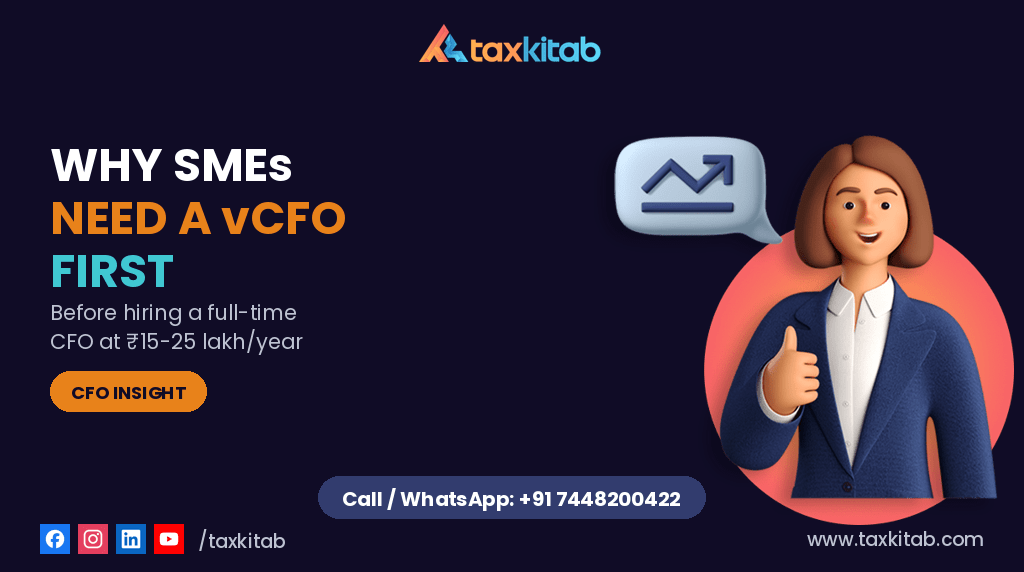
A genuine full-time CFO hire, once you account for the full package rather than just a headline salary number, typically runs well into the ₹15-25 lakh range annually, often higher depending on the market and the role’s scope. That’s a serious fixed commitment for a business that, realistically, needs the strategic function but not necessarily a dedicated senior executive sitting in the office every day.
What a vCFO Actually Does Differently
A virtual CFO isn’t a watered-down, part-time version of the same role. It’s the same strategic function — financial planning, MIS reporting, cash flow management, fundraising readiness, board-level financial guidance — delivered on a structure that scales to what a growing business genuinely needs right now, rather than forcing a full-time fixed cost before the business is ready to absorb it.
Signs You’re Already Past the Point Where This Matters
These show up regardless of company size or industry:
- You’re making real decisions — pricing changes, a hiring push, a new product line — based on gut feel because you don’t have monthly numbers telling you where the business actually stands.
- A bank or investor asked for CMA data or financial projections, and producing it took days of scrambling rather than a straightforward pull from existing reports.
- Revenue is growing, but you genuinely don’t know whether your margins are improving alongside it or quietly eroding underneath a bigger top line.
- Someone is keeping your books accurate and your compliance current, but nobody is actually interpreting what those numbers mean for the decisions you’re making month to month.
If two or more of these sound familiar, the gap isn’t bookkeeping. It’s the layer above bookkeeping that turns numbers into decisions — and that’s specifically what a vCFO function fills.
Accounting and vCFO Are Not the Same Service, and Confusing Them Is Common
| Accounting & Bookkeeping | Virtual CFO | |
| What it focuses on | Recording transactions accurately and on time | Interpreting what the numbers mean for decisions |
| What you get | Ledgers, GST/TDS compliance, financial statements | MIS reports, cash flow forecasts, strategic financial input |
| How often it runs | Continuous, transactional | Ongoing oversight plus periodic strategic review |
| Who it’s for | Every business, without exception | Businesses actively making growth, funding, or structural decisions |
A lot of businesses assume that once their bookkeeping is solid, they’ve covered their financial needs. Bookkeeping tells you what happened. A vCFO function tells you what to do about it.
Last Updated: June 2026
Reviewed By: TaxKitab Advisory Team
Frequently Asked Questions
How much does a vCFO for growing SMEs typically cost compared to a full-time hire?
It varies by scope and frequency of engagement, but the structural advantage of a vCFO for growing SMEs is that you’re paying for a fraction of senior strategic time rather than a full annual salary, benefits, and overhead. The exact figure depends on how much oversight and reporting frequency your business needs.
Can a vCFO for growing SMEs work alongside our existing accountant or bookkeeper?
Yes — in fact, this is the typical setup. The vCFO function builds on top of accurate bookkeeping rather than replacing it. Your accountant keeps the records correct; the vCFO interprets what those records mean and advises on decisions.
How quickly can a vCFO for growing SMEs actually get up to speed on our business?
This depends on how organized your existing financial records are. If your bookkeeping is current and accurate, a vCFO can typically start producing useful MIS reports within the first month. If records need cleanup first, that adds time upfront but is a one-time cost, not a recurring one.
Is a vCFO only useful for businesses planning to raise funding?
No — fundraising readiness is one use case, but the more common reason businesses bring in a vCFO is simply for better day-to-day financial visibility and decision support, independent of any funding plans.
| Item | Full-Time CFO | vCFO |
|---|---|---|
| Annual Cost | ₹15–25L+ | Fraction of cost |
| Strategic Guidance | Yes | Yes |
| Daily Presence | Yes | Limited |
| Best For | Large businesses | Growing SMEs |
When the Full-Time Hire Genuinely Becomes the Right Call
There’s a real point where a full-time CFO makes more sense than a virtual one — usually when the finance function has grown complex enough to need someone physically embedded daily, managing an internal team, deeply woven into day-to-day operational decisions rather than periodic strategic review. Most growing SMEs aren’t there yet, and a meaningful number never need to make that jump at all, because a properly structured vCFO relationship scales alongside the business rather than capping out.
If You’re Not Sure Which Stage You’re At
Related Reading
- What Does a Virtual CFO Do for Growing Businesses?
- What a Virtual CFO’s Monthly MIS Report Actually Looks Like
- The Importance of Outsourcing Accounting Services for Small Businesses
Need help with this? TaxKitab handles Virtual CFO Services for businesses across India and overseas. You may also find our Compliance Calendar useful. Talk to us.
This is a conversation worth having before committing to either path, not after. We’ll look at where your business actually stands — not where you think it should be — and tell you honestly whether a vCFO function solves your current gap or whether you’re genuinely at the point of needing something more.Call or WhatsApp: +91 7448200422Email: info@taxkitab.comWebsite: taxkitab.comSee our Virtual CFO Services page, or get in touch via Contact.