
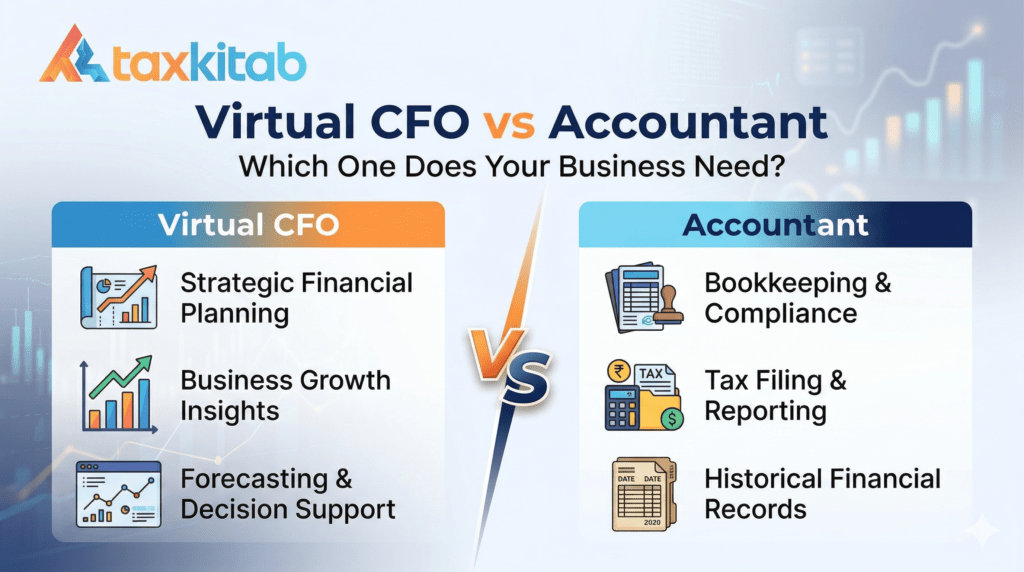
Most businesses begin their financial journey with an accountant. Transactions are recorded, taxes are filed, compliance is managed, and for a long time, that feels sufficient. However, as operations grow and financial decisions become more complex, something changes. Founders find themselves needing more than accurate records; they need strategic guidance.
This is the stage at which the comparison between a virtual CFO vs accountant becomes genuinely important. Both roles support financial management, but their responsibilities, their focus, and the value they deliver are fundamentally different.
Choosing the right financial support at the right time directly impacts your decision-making quality, your growth trajectory, and your financial stability. In this guide, we explain the key differences between a Virtual CFO and an accountant so you can make the right choice for your business.
What Does an Accountant Do?
An accountant is responsible for the accurate recording, organization, and reporting of a business’s financial transactions. They ensure that financial records are complete, compliant with applicable regulations, and ready for statutory filings.
Core accountant responsibilities include:
- Bookkeeping: Recording daily financial transactions, sales, expenses, payments, and receipts accurately and consistently
- Tax filing: Preparing and submitting GST returns, TDS filings, advance tax payments, and annual income tax returns
- Financial statements: Generating profit and loss statements, balance sheets, and cash flow reports on a regular basis
- Compliance reporting: Ensuring all financial obligations are met accurately and on time, reducing the risk of penalties and regulatory notices
An accountant is fundamentally focused on the past, documenting what has already happened and ensuring it is reported correctly. They are the financial historian of the business, and their work provides the foundational data that supports everything else.
What Does a Virtual CFO Do?
A Virtual CFO provides senior financial leadership on a remote, flexible basis. They use the financial data that accountants produce and transform it into strategic insights, plans, and guidance that drive better business decisions.
Core Virtual CFO responsibilities include:
- Budgeting and forecasting: Building realistic financial plans and projections that align with business goals and resource availability
- Cash flow management: Monitoring liquidity, identifying gaps before they occur, and ensuring the business always has the cash it needs
- Financial analysis: Interpreting financial reports, identifying trends and risks, and explaining what the numbers mean for the business
- Growth planning: Modelling the financial impact of expansion decisions, new markets, additional hires, and product launches before resources are committed
- Strategic guidance: Advising founders on pricing, investment, capital structure, and financial risk management at every stage of growth
A Virtual CFO is fundamentally focused on the future, using past data to inform what happens next. They are the financial strategist of the business, and their work determines the quality of every major decision the founder makes.
Virtual CFO vs Accountant: Key Differences
Here is a clear, side-by-side comparison of the accountant vs CFO difference across every dimension that matters for growing businesses.
| Dimension | Accountant | Virtual CFO |
| Primary Role | Records and reports financial data | Analyzes data and guides strategy |
| Focus Area | Past — what has already happened | Future — what should happen next |
| Key Output | Accurate statements and tax filings | Strategic plans, forecasts, insights |
| Level of Involvement | Operational and compliance-focused | Strategic and decision-focused |
| Cost Structure | Fixed salary or service fee | Flexible, service-based pricing |
| Business Impact | Ensures compliance and accuracy | Drives growth and financial clarity |
| Best Suited For | Early-stage or compliance-focused businesses | Growing businesses needing strategic guidance |
1. Role and Responsibility
An accountant’s role is operational; they record transactions, prepare financial statements, and ensure compliance with tax and regulatory requirements. Their primary output is accurate historical financial data.
A Virtual CFO’s role is strategic; they analyze that data, identify trends and risks, and provide guidance on what actions the business should take. Therefore, roles differ significantly even though both work with financial information. One produces the data; the other interprets it and acts on it.
2. Focus Area
An accountant focuses on the past, ensuring that every transaction is recorded correctly and that financial reports accurately reflect what has already happened. Reporting accuracy is their primary measure of success.
A Virtual CFO focuses on the future using past financial data to forecast what is coming, plan what should happen, and guide decisions about growth, investment, and risk. As a result, accounting vs financial strategy represents fundamentally different orientations, both of which are necessary for a well-run business.
3. Level of Strategic Involvement
An accountant’s involvement is primarily operational. They work within defined processes, recording entries, reconciling accounts, preparing filings, and typically provide limited strategic input beyond their compliance function.
A Virtual CFO is actively involved in strategic decision-making. They sit alongside founders in discussions about expansion, funding, pricing, and financial structure, providing the financial analysis that makes those conversations substantive rather than speculative. This adds significantly higher value for growing businesses navigating complex financial decisions.
4. Cost Structure
Accountants are typically engaged on a fixed salary basis if in-house, or a defined service fee if outsourced, covering a standard scope of bookkeeping, compliance, and reporting work.
Outsourced CFO services operate on flexible, service-based pricing. The engagement scope and cost scale with the complexity and needs of the business, making it accessible for growing SMEs who need senior financial expertise without the overhead of a full-time executive. Therefore, businesses can choose the model that best fits their current needs and budget.
5. Business Impact
An accountant’s impact is primarily protective, ensuring the business remains compliant, avoids penalties, and maintains accurate financial records. This is essential and must not be underestimated.
A Virtual CFO’s impact is generative, driving better decisions, improving cash flow management, accelerating growth, and building the financial foundation that makes the business more valuable and more resilient. Both roles remain important, and they deliver their greatest combined value when used together.
When Should You Choose an Accountant?
An accountant is the right choice and often the only support needed when:
- Early-stage business: Transaction volumes are low, operations are simple, and the primary financial need is accurate record-keeping and compliance.
- Basic bookkeeping needs: The business needs consistent transaction recording, bank reconciliation, and financial statement preparation without requiring strategic analysis.
- Limited financial complexity: One revenue stream, straightforward expenses, and a compliance-focused regulatory environment that does not require advanced financial management.
- Compliance-first priority: GST, TDS, and ITR obligations are well-managed, and the primary financial goal is accuracy and regulatory adherence rather than strategic growth planning.
When Does Your Business Need a Virtual CFO?
Small business financial management requires a step-change in expertise when any of the following conditions are present:
- Growing business with increasing complexity: More revenue streams, more team members, more compliance obligations, and more operational complexity than basic accounting can effectively manage.
- Complex financial decisions: Choices around expansion, hiring, pricing, investment, or restructuring require financial modelling and strategic guidance beyond compliance expertise.
- Cash flow challenges: Inconsistent or unpredictable cash flow requires structured planning, forecasting, and proactive management functions that fall outside a standard accounting engagement.
- Expansion planning: Entering new markets, scaling the team, or launching new products requires a financial plan and scenario analysis that only a CFO-level professional can provide.
- Preparing for investment: Investors expect clean books, credible forecasts, and a compelling financial narrative none of which an accountant alone can deliver.
Therefore, a Virtual CFO becomes essential when financial decisions start requiring strategic expertise that goes beyond what accurate record-keeping alone can support.
Can Businesses Use Both an Accountant and a Virtual CFO?
Yes, and this is in fact the most effective model for most growing businesses. Accountants and Virtual CFOs are not competing alternatives. They are complementary functions that work together to cover the full spectrum of financial management.
The accountant maintains accurate, compliant financial records. The Virtual CFO uses those records to provide strategic guidance, financial planning, and growth direction. Therefore, both roles complement each other, with the accountant building the financial foundation and the Virtual CFO building the financial strategy on top of it.
For growing businesses, having both functions in place, whether through separate providers or an integrated financial management service, delivers complete financial coverage without gaps.
Common Mistakes Businesses Make
Many businesses make avoidable errors when managing the virtual CFO vs accountant decision. Here are the most common:
- Relying on accountants for strategic decisions: Asking an accountant to provide strategic financial guidance is like asking a historian to predict the future. They work with past data; they are not equipped to provide a forward-looking financial strategy.
- Ignoring financial planning entirely: Some businesses have an accountant but no structured financial plan, budget, or cash flow forecast. As a result, every major decision is made without a financial framework to evaluate it against.
- Delaying strategic support too long: By the time most businesses engage CFO-level support, financial complexity has already accumulated. Acting earlier builds a stronger foundation and avoids the costly correction of accumulated mistakes.
- Misunderstanding role differences: Assuming that an accountant and a Virtual CFO do the same thing, just at different price points, leads to buying the wrong type of support and leaving critical financial gaps unaddressed.
How to Decide What Your Business Needs
Use these five questions to clarify which financial support model is right for your business right now:
- Is your business growing rapidly? If yes, you likely need more than compliance management; you need strategic financial oversight to ensure growth is sustainable and well-managed.
- Do you need strategic financial guidance? If you are making decisions on expansion, investment, or funding without financial analysis to support them, a Virtual CFO is essential.
- Are financial decisions becoming more complex? Multiple revenue streams, growing payroll, increasing compliance requirements, and cash flow management all signal that CFO-level support is needed.
- Do you have clear financial visibility? If you cannot clearly explain your business’s cash position, profitability trend, or key financial metrics at any given time, you need a Virtual CFO, not just an accountant.
- Are you preparing for an investment or a major expansion? Both scenarios require investor-ready financials, detailed forecasts, and a CFO-level financial narrative that an accountant alone cannot deliver.
Conclusion
Understanding the difference between a virtual CFO vs accountant helps businesses make informed, strategic financial decisions. Both roles are valuable, but they serve entirely different purposes and deliver fundamentally different types of value.
Accountants ensure accurate records and compliance. However, Virtual CFOs provide the strategic financial guidance that transforms those records into decisions, plans, and growth. As financial complexity increases with business growth, relying on accounting alone is no longer sufficient.
Therefore, choosing the right combination of financial support or recognizing when the time has come to add CFO-level expertise helps businesses improve stability, make better decisions, and achieve long-term growth with genuine financial clarity.
Choosing the right financial support at the right stage directly impacts your business growth, decision quality, and long-term stability. Our Virtual CFO services help growing businesses gain financial clarity, improve their strategic decision-making, and scale with confidence, complementing your existing accounting function with the expert guidance it cannot provide alone.
Frequently Asked Questions
An accountant focuses on recording financial transactions accurately, preparing reports, and ensuring compliance with tax regulations. A Virtual CFO uses those records to provide strategic financial guidance, including budgeting, forecasting, cash flow management, and business growth planning. The core difference is orientation: an accountant looks backward at what happened, while a Virtual CFO looks forward at what should happen next.
Small businesses benefit from a Virtual CFO when their financial decisions begin to require strategic expertise beyond what compliance-focused accounting provides. If cash flow is unpredictable, financial decisions feel risky or unclear, the business is preparing for funding, or the founder is spending too much time on financial management, it is time to consider Virtual CFO support. For many growing SMEs, the combination of an accountant and a Virtual CFO provides complete financial coverage.
Yes, and this is the most effective model for most growing businesses. Accountants manage financial records and compliance; Virtual CFOs use those records to provide strategic guidance and planning. The roles are complementary, not competitive. Together, they cover the full spectrum of financial management from accurate historical data to forward-looking strategy.
Virtual CFO services are typically priced higher than standard accounting services because they deliver a higher level of strategic expertise and business impact. However, they operate on a flexible, service-based model so businesses pay for the scope they need without the overhead of a full-time executive hire. When compared to the total cost of a full-time in-house CFO, virtual CFO services are significantly more cost-effective for most growing businesses.
Most accountants are not trained or engaged to provide strategic financial guidance. Their expertise is in recording accuracy, compliance, and reporting, all of which are operational functions rather than strategic ones. Some experienced accountants may offer basic financial advice, but this is fundamentally different from the structured financial strategy, forecasting, and business planning that a Virtual CFO provides. Expecting strategic guidance from a compliance-focused engagement creates a critical gap in financial leadership.
The clearest signals are when financial decisions start feeling risky or unclear, when cash flow becomes unpredictable, when major business decisions need financial modelling to evaluate, or when the business is preparing for significant growth or investment. At that point, accurate accounting records alone are no longer sufficient; you need someone who can interpret those records and guide what happens next. A Virtual CFO bridges that gap without the cost of a full-time hire.
Related Reading
What Does a Virtual CFO Do for Growing Businesses?
How a Virtual CFO Improves Cash Flow Management
When Should a Startup Hire a Virtual CFO?
US businesses can see Accounting Services USA for how we handle bookkeeping on your own QuickBooks or Xero subscription.
Related Reading
- Why Growing SMEs Need a vCFO Before a Full-Time CFO
- What Banks Actually Check Before Approving an SME Loan
- Switching Accountants Mid-Year: What to Actually Hand Over
Need help with this? TaxKitab handles Virtual CFO Services for businesses across India and overseas. You may also find our TaxKitab Books useful. Talk to us.