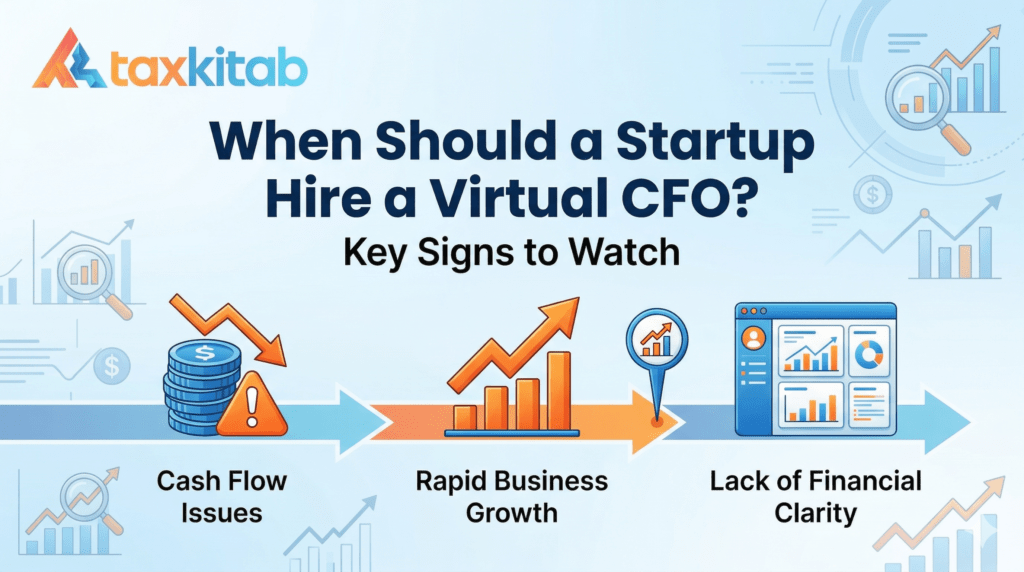
Startups dedicate enormous energy to growth, product development, and customer acquisition. Financial management, however, often receives far less attention, at least until the consequences of ignoring it become impossible to overlook. As operations expand and revenue increases, financial decisions grow more complex, and founders begin asking a critical question: when to hire a virtual CFO?
Without structured financial guidance, startups face unpredictable cash flow, unclear profitability, and a growing risk of making major decisions without the data to support them. Therefore, the timing of when you bring in senior financial expertise matters enormously.
In this guide, we explain the key signs that indicate your startup is ready for a Virtual CFO, what this role delivers, and how acting at the right time can make the difference between scaling confidently and stumbling through financial complexity without support.
If you recognise yourself in more than two of these, our Virtual CFO service sets out what a monthly engagement actually includes
What Does a Virtual CFO Do for Startups?
A Virtual CFO provides strategic financial leadership for startups on a flexible, remote basis. They are not simply an accountant who records transactions, they are a senior financial advisor who helps founders make smarter decisions, plan for growth, and navigate financial complexity with confidence.
For startups, a Virtual CFO typically helps with:
- Budgeting and forecasting: Building realistic financial plans based on actual data rather than optimistic assumptions
- Startup cash flow management: Tracking inflows and outflows, identifying gaps early, and ensuring liquidity at every stage
- Financial reporting and analysis: Generating clear, investor-ready reports that show the true financial health of the business
- Growth planning: Modelling the financial impact of expansion decisions, new hires, market entry, and product launches before resources are committed
- Risk management: Identifying financial vulnerabilities and putting strategies in place to manage them proactively
Unlike an accountant who focuses on what has already happened, a Virtual CFO focuses on what is happening now and what should happen next. As a result, startups gain a financial partner who is actively supporting their growth, not just documenting it.
Why Startups Struggle with Financial Management
Startup financial management presents a unique set of challenges that most founders are not fully equipped to handle alone. Understanding these challenges helps explain why so many growing startups eventually find themselves in financial difficulty and why expert support matters so much.
- Limited financial expertise: Most startup founders are experts in their product or market, not in financial strategy, cash flow modelling, or compliance management.
- Unpredictable revenue cycles: Early-stage startups rarely have stable, consistent income. Revenue can vary dramatically from month to month, making financial planning significantly more difficult.
- High operational expenses relative to income: Startups frequently spend heavily on growth hiring, marketing, and technology before revenue fully catches up, creating persistent cash flow pressure.
- Lack of structured financial planning: Without a formal budget, forecast, or cash flow plan, startups make decisions reactively, responding to financial problems rather than anticipating and preventing them.
As a result, financial clarity becomes elusive, and the consequences of operating without it grow more serious with every phase of growth.
Key Signs Your Startup Needs a Virtual CFO
These are the clearest indicators that the right time to hire a Virtual CFO has arrived. If your startup is experiencing any of the following, expert financial support is no longer optional; it is essential.
1. Cash Flow Feels Unpredictable
Your startup is generating revenue, but cash shortages still occur without warning. Money arrives and disappears, and it is unclear whether there will be enough to cover next month’s obligations. This is one of the most common and most dangerous financial patterns in early-stage businesses.
Unpredictable cash flow is almost always a symptom of poor planning rather than insufficient income. Therefore, a Virtual CFO who specializes in startup cash flow management can diagnose the root causes, build a forward-looking cash flow plan, and put processes in place that make your financial position predictable and manageable.
2. Financial Decisions Feel Unclear or Risky
Founders are making major decisions on pricing, hiring, investment, and expansion, but without reliable financial data to back them up. Decisions are driven by gut feeling, optimism, or urgency rather than structured financial analysis.
This increases the risk significantly. A single poorly-timed decision, such as hiring too quickly or entering a market before the business can sustain the cost, can have a lasting financial impact. A Virtual CFO provides structured insights and financial modelling that replace guesswork with clarity. As a result, every major decision is grounded in data rather than assumption.
3. Your Business Is Growing Rapidly
Growth is exciting, but it brings financial complexity that many startups are unprepared for. More customers, more team members, more vendors, more compliance obligations, and more capital requirements all land at once. The financial systems that worked at an earlier stage quickly become inadequate.
Therefore, financial planning becomes essential, not optional. A Virtual CFO for startups steps in at exactly this stage to build the financial infrastructure the business needs to scale sustainably. They ensure that growth is supported by sound financial management rather than undermined by it.
4. You Are Spending Too Much Time on Financial Admin
Founders should be building the business, developing products, acquiring customers, and leading the team. However, when financial management is left without a dedicated owner, it defaults to the founder. Hours that should go toward growth get absorbed by bookkeeping, chasing invoices, reconciling accounts, and preparing reports.
This is one of the clearest signals that it is time to bring in outsourced CFO services. A Virtual CFO takes full ownership of financial management, freeing the founder to focus entirely on what they do best. The result is better productivity and a stronger business.
5. You Are Preparing for Funding or Investment
Investors and lenders do not invest in ideas alone; they invest in businesses with credible financial foundations. They expect clean financial records, accurate forecasts, clear performance metrics, and a compelling financial narrative that demonstrates the business is being managed professionally.
A Virtual CFO prepares startups for this scrutiny. They build investor-ready financial reports, develop multi-scenario forecasts, and help founders communicate the financial story of their business confidently. Attempting to raise funding without this level of preparation significantly reduces the chances of success and reflects poorly on the business’s credibility.
6. Compliance and Reporting Are Becoming Complex
As startups grow, their regulatory and compliance obligations grow with them. GST registration, TDS deductions, advance tax payments, ITR filings, and payroll compliance are these requirements that multiply quickly and carry real penalties for errors or delays.
Managing compliance without structured financial systems and expert oversight is increasingly risky. Therefore, startups need the kind of organized, professional financial management that a Virtual CFO brings, ensuring that every regulatory obligation is met accurately and on time, without disrupting day-to-day operations.
Benefits of Hiring a Virtual CFO for Startups
Here is a clear summary of what CFO services for small businesses and startups deliver in practical terms:
| Benefit | What It Delivers for Your Startup |
| Better financial planning | Structured budgets and forecasts replace guesswork with data-driven financial direction |
| Improved cash flow control | Proactive monitoring ensures consistent liquidity and eliminates unexpected cash shortages |
| Strategic decision-making | Every major business decision is backed by financial analysis and expert guidance |
| Cost-effective expertise | CFO-level guidance at a fraction of the cost of a full-time executive hire |
| Scalable financial support | Engagement grows with your business — no hiring delays, no fixed role constraints |
| Investor readiness | Clean records, accurate forecasts, and a credible financial story for fundraising conversations |
When Is the Right Time to Hire a Virtual CFO?
The right time to know when to hire a Virtual CFO is different for every startup. However, it consistently depends on a combination of the following factors, and the clearer you are on each one, the easier the decision becomes.
- Revenue growth: When revenue is growing consistently, and financial complexity is increasing alongside it, structured financial management becomes a necessity rather than a luxury.
- Operational complexity: When the business has multiple revenue streams, team members, vendors, and compliance obligations that need coordinated financial oversight.
- Visible financial challenges: When cash flow is unpredictable, financial reports are unreliable, or compliance is becoming a recurring source of stress, it is already time to act.
- Future expansion plans: Before entering a new market, launching a new product line, or scaling the team significantly, you need financial modelling and strategic guidance to make the right call.
Therefore, startups should act before financial issues compound, not after. The earlier you establish structured financial management, the stronger the foundation you build for everything that follows.
Common Mistakes Startups Make with Financial Management
Many startups delay financial expertise until the damage has already been done. Here are the most common mistakes and why they matter:
- Delaying financial planning: Assuming that financial strategy is something to address later, after the product is built or the team is in place, means making every early decision without the data to support it.
- Relying only on basic bookkeeping: Bookkeeping records what happened. It does not tell you what to do next. Without strategic financial guidance, startups know their numbers but cannot act on them effectively.
- Ignoring cash flow warning signs: Treating cash shortages as temporary inconveniences rather than structural issues means the same problem recurs each time with more serious consequences.
- Hiring a Virtual CFO too late: By the time most startups engage CFO support, financial complexity has already accumulated for months, making the correction process longer and more costly than it needed to be.
These mistakes affect long-term growth and survival. However, they are entirely avoidable when the right financial support is in place at the right time.
Conclusion
Understanding when to hire a Virtual CFO helps startups build strong financial foundations before complexity overwhelms them. The signs are consistent across most growing startups unpredictable cash flow, unclear financial decisions, rapid growth, time pressure on the founder, fundraising preparation, or mounting compliance obligations.
As startups grow, financial complexity increases. Therefore, structured financial guidance becomes essential, not a cost to be deferred, but a strategic investment that pays back many times over in better decisions, avoided mistakes, and faster growth.
A Virtual CFO provides clarity, improves decision-making, and gives startups the financial leadership they need to scale with confidence. Taking action at the right time is what separates startups that thrive from those that struggle with challenges that were always preventable.
Strong financial planning supports sustainable startup growth. Our Virtual CFO services help startups manage finances strategically, improve cash flow, prepare for investment, and build the financial foundations needed for long-term success without the cost of a full-time executive hire.
Frequently Asked Questions
A startup should hire a Virtual CFO when financial decisions are becoming complex, cash flow is unpredictable, compliance requirements are increasing, or the founder is spending too much time on financial management instead of growing the business. As a general rule, the right time is before financial issues compound, not after. Early engagement builds a stronger financial foundation and prevents problems that are significantly more costly to fix later.
Yes, absolutely. Virtual CFO for startups is well-suited to early-stage businesses because it provides expert financial guidance without the cost of a full-time hire. Early-stage startups benefit particularly from cash flow planning, budgeting, and financial forecasting, areas where professional guidance can prevent the cash flow crises that derail so many promising businesses before they reach their growth potential.
The core benefits include better financial planning, improved cash flow control, data-driven strategic decision-making, investor readiness, compliance oversight, and significant cost savings compared to a full-time CFO hire. Startups also gain access to cross-industry expertise and a financial partner who actively supports growth, not just records it.
A Virtual CFO prepares startups for investor conversations by building clean financial records, developing accurate multi-scenario forecasts, and creating the financial narrative that investors expect to see. They also help founders understand and confidently communicate key financial metrics such as burn rate, runway, unit economics, and growth trajectory, which are critical in any fundraising process.
A startup accountant focuses on recording transactions, preparing financial statements, and managing tax compliance, all looking backward at what has already happened. A Virtual CFO focuses on what is happening now and what should happen next, providing strategic guidance, financial planning, and forward-looking analysis that directly support growth decisions. Both roles are valuable and complement each other, but they serve fundamentally different purposes.
Yes. A Virtual CFO is equally valuable for startups that are already experiencing financial difficulties. They start by diagnosing the root causes, whether cash flow mismanagement, uncontrolled expenses, compliance gaps, or poor planning, and build a structured recovery plan. Therefore, engaging a Virtual CFO during a difficult period can prevent those challenges from becoming existential and set the business up for a more stable and sustainable path forward.
Related Reading
What Does a Virtual CFO Do for Growing Businesses?
Essential Financial Reports Every SME Must Track for Better Financial Control
Virtual CFO vs In-House CFO: Cost & Benefit Comparison
Related Reading
- How a Virtual CFO Improves Cash Flow Management for Growing Businesses
- Key Financial Metrics Every Founder Must Track for Business Growth
- Why Businesses Should Outsource Bookkeeping Services?
Need help with this? TaxKitab handles Virtual CFO Services for businesses across India and overseas. You may also find our Managed Compliance useful. Talk to us.
-
Pingback: Key Financial Metrics Every Founder Must Track