
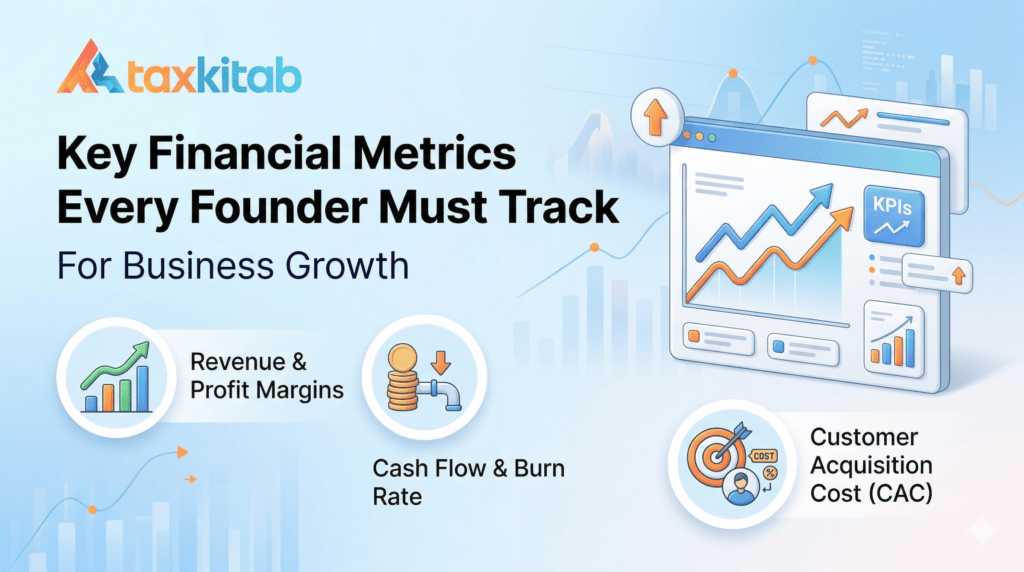
Many founders focus almost entirely on revenue growth but ignore the deeper financial clarity that actually drives sustainable business performance. As a result, they find themselves making major decisions without truly understanding their business’s financial health.
Financial metrics for founders are not just numbers on a report. They are the signals that tell you whether your business is genuinely growing, where value is being created or lost, and what actions to take next. Without consistently tracking the right metrics, decision-making becomes guesswork.
In this guide, we explain the eight most important financial metrics every founder should track, why they matter, and how monitoring them regularly supports smarter decision-making, stronger growth, and long-term business stability.
What Are Financial Metrics?
Financial metrics are quantifiable measurements that evaluate business performance across key dimensions. They convert raw financial data into meaningful, comparable figures that help founders understand how the business is operating and where it needs to improve.
Key business metrics for startups and growing businesses help founders understand:
- Profitability: Is the business generating genuine profit, or just revenue?
- Cash flow: Is there enough cash available at all times to sustain and grow the business?
- Efficiency: Are resources being used in the most productive way possible?
- Growth: Is the business expanding at a sustainable rate?
Therefore, financial metrics support informed decision-making at every level of the business, from day-to-day operations to long-term strategy.
Why Financial Metrics Matter for Founders
Founders who track the right metrics consistently have a significant advantage over those who do not. Here is why financial KPIs for SMEs and startups are essential, not optional:
- Business health clarity: Metrics reveal the true financial condition of the business, not just the top-line revenue number that can mask underlying problems.
- Strategic planning support: Data-driven planning is more accurate, more credible, and more actionable than plans built on intuition alone.
- Early risk identification: Trends in financial metrics often signal emerging problems such as declining margins or slowing collections weeks or months before they become crises.
- Financial discipline: Regularly reviewing metrics keeps founders accountable to financial targets and creates a culture of data-driven management across the business.
Without tracking these metrics, businesses rely entirely on assumptions. As a result, decisions carry significantly higher risk, and opportunities for improvement go undetected until the damage is already done.
Key Financial Metrics Every Founder Must Track
Here are the eight startup financial performance metrics that provide the most comprehensive and actionable picture of business health.
| Metric | What It Measures | Review Frequency |
| Revenue Growth Rate | Speed of business revenue expansion | Monthly |
| Gross Profit Margin | Profitability after direct costs | Monthly |
| Net Profit Margin | Actual profit after all expenses | Monthly |
| Cash Flow | Money in vs. money out | Weekly / Monthly |
| Burn Rate | Speed of cash consumption (startups) | Monthly |
| Customer Acquisition Cost | Cost to acquire one new customer | Monthly |
| Lifetime Value (LTV) | Total revenue per customer relationship | Quarterly |
| Accounts Receivable Turnover | Speed of customer invoice collection | Weekly / Monthly |
1. Revenue Growth Rate
Revenue growth rate measures the percentage increase in total revenue over a defined period, typically month-on-month or year-on-year. It is the most direct indicator of business momentum and market traction.
Therefore, founders understand whether the business is genuinely accelerating or beginning to plateau. A declining growth rate, even when absolute revenue remains high, is a critical early warning signal that deserves immediate attention. Tracking this business growth metric consistently removes ambiguity about the business trajectory.
2. Gross Profit Margin
Gross profit margin measures the percentage of revenue remaining after deducting the direct costs of producing or delivering your product or service. It is calculated as: (Revenue minus Cost of Goods Sold) divided by Revenue, expressed as a percentage.
Higher gross margins indicate better cost control and stronger pricing power. This metric helps founders evaluate the financial efficiency of their core business model and identify whether rising costs are quietly eroding profitability before it shows up in the net profit line.
3. Net Profit Margin
Net profit margin shows the actual profit remaining after all expenses, including operating costs, salaries, taxes, interest, and depreciation, have been deducted from revenue. It is the truest measure of overall business profitability.
Therefore, founders can assess whether the business is genuinely sustainable, not just generating revenue, but actually retaining value from it. A business with strong revenue but thin net margins may be working very hard for very little actual return. This CFO financial metric is central to understanding long-term viability.
4. Cash Flow
Cash flow tracks the actual movement of money into and out of the business and is entirely distinct from profit. A business can be profitable on paper while simultaneously running out of cash if customers are paying late, expenses are front-loaded, or growth is consuming working capital faster than revenue generates it.
Positive cash flow ensures smooth daily operations, paying salaries, vendors, and tax obligations without disruption. As a result, businesses with strong cash flow management avoid the operational crises that derail otherwise promising companies. This is one of the most critical financial metrics for founders to monitor at all times.
5. Burn Rate (For Startups)
Burn rate measures how quickly a startup is spending its available cash reserves in a given month. It is calculated as the net cash outflow, the difference between what comes in and what goes out. Closely linked to burn rate is the concept of runway how many months of operation the business can sustain at the current burn rate before running out of cash.
Therefore, burn rate supports survival planning. Knowing your runway at all times gives founders the clarity to make strategic decisions, such as when to raise the next funding round, where to reduce spending, or when to accelerate revenue generation. Ignoring this metric until the runway is nearly exhausted is one of the most dangerous mistakes a startup can make.
6. Customer Acquisition Cost (CAC)
Customer Acquisition Cost measures the total cost of acquiring a single new customer, including marketing spend, sales team costs, advertising, and any other direct acquisition expenses, divided by the number of new customers acquired in the same period.
A lower CAC indicates that the business is acquiring customers efficiently. Tracking CAC over time also helps founders evaluate the effectiveness of different marketing channels, identifying which acquisition strategies deliver the best return and which are consuming budget without proportional results. This metric is essential for maintaining profitability as the business scales its customer acquisition efforts.
7. Customer Lifetime Value (LTV)
Lifetime Value measures the total revenue a business can expect to generate from a single customer over the entire duration of their relationship. It combines average purchase value, purchase frequency, and average customer lifespan into a single forward-looking metric.
Therefore, LTV supports a long-term growth strategy. The relationship between LTV and CAC is particularly telling if your LTV is significantly higher than your CAC, the business model is financially healthy. If they are close or reversed, it signals a structural problem with unit economics that needs to be addressed before scaling further.
8. Accounts Receivable Turnover
Accounts receivable turnover measures how quickly the business collects payments from customers after invoicing. It is calculated by dividing total credit sales by the average accounts receivable balance over a period.
Faster collection directly improves cash flow. Therefore, businesses that monitor this metric and actively manage their receivables maintain stronger liquidity and avoid the cash shortages that arise when invoices go unpaid for extended periods. A declining receivable turnover ratio is an early warning that collections are slowing and corrective action is needed before cash flow is affected.
How to Track Financial Metrics Effectively
Knowing which metrics to track is only half the equation. Tracking them consistently and accurately requires the right processes and habits in place.
- Maintain accurate bookkeeping: Every metric is only as reliable as the underlying financial records. Consistent, accurate bookkeeping is the foundation of meaningful metric analysis.
- Use accounting software: Tools like Tally, Zoho Books, or QuickBooks automate data collection, generate reports on demand, and reduce the manual effort required to compile and analyze financial data.
- Review reports monthly: Set a fixed date each month to review your key financial reports and metrics. Monthly review maintains momentum, catches problems early, and keeps financial performance visible.
- Set clear financial goals: Define target values for each metric growth rate targets, margin benchmarks, and cash flow thresholds so that deviations are immediately obvious and actionable.
- Monitor trends regularly: A single month’s metric is useful context. A trend over six or twelve months is strategic intelligence. Always look at metrics in the context of their direction over time.
Common Mistakes Founders Make with Financial Metrics
Even founders who understand the importance of financial metrics can fall into patterns that reduce their effectiveness. Here are the most common errors:
- Tracking too many metrics: Attempting to monitor every possible financial indicator creates noise rather than clarity. Focus on the eight core metrics outlined in this guide before expanding your tracking framework.
- Ignoring cash flow: Many founders focus exclusively on revenue and profit, and discover too late that they have a cash flow problem that neither metric was showing. Cash flow must always be monitored independently.
- Not reviewing metrics regularly: Metrics reviewed once a quarter or only at year-end lose much of their value. A monthly review is the minimum frequency for meaningful financial monitoring.
- Misinterpreting financial data: A metric in isolation can be misleading. Net profit of 10% means very different things in a high-margin SaaS business versus a low-margin trading business. Context and benchmarks are essential.
How a Virtual CFO Helps Track Financial Metrics
Tracking financial metrics well requires more than just access to the numbers; it requires the expertise to identify which metrics matter most for your specific business, interpret what they mean in context, and act on what they reveal. This is precisely where a Virtual CFO adds exceptional value.
- Identifies the right metrics for your business: A Virtual CFO helps founders focus on the financial KPIs for SMEs that are most relevant to their business model, stage, and growth goals.
- Tracks performance on a structured schedule: Regular review cycles are built into the engagement, so metrics are monitored consistently, not only when a problem is already visible.
- Explains financial insights in plain terms: A Virtual CFO translates complex financial data into clear, actionable business language so founders understand exactly what the numbers are saying and what to do about it.
- Supports strategic decisions with data: Every major business decision, hiring, pricing, expansion, and investment is evaluated against the financial metrics that reveal whether it is the right move at the right time.
Therefore, founders gain not just data but genuine financial clarity and the confidence to act on it. This is the difference between tracking metrics as a reporting exercise and using them as a genuine strategic management tool.
Conclusion
Tracking the right financial metrics for founders is one of the highest-leverage habits a business owner can develop. These metrics provide clear, consistent insights into profitability, growth momentum, cash position, and customer economics, the four dimensions that determine whether a business is building toward long-term success or quietly drifting toward instability.
Therefore, these metrics support better decision-making at every stage of growth from early-stage survival planning to scaling strategy and investor preparation. As businesses grow, managing financial data becomes more complex. A structured approach to tracking and interpreting the right metrics ensures that complexity never becomes confusion.
With the right numbers tracked consistently and interpreted accurately, founders can lead their businesses with clarity, confidence, and a genuine understanding of where they stand and where they are going.
Understanding and tracking the right financial metrics helps founders make smarter, faster, and more confident business decisions. Our Virtual CFO services help businesses identify key performance metrics, track financial health consistently, and build the strategic clarity needed to grow sustainably.
Frequently Asked Questions
The eight most important financial metrics for founders are revenue growth rate, gross profit margin, net profit margin, cash flow, burn rate (for startups), customer acquisition cost, lifetime value, and accounts receivable turnover. Together, these metrics provide a comprehensive picture of business performance covering profitability, growth momentum, cash position, and customer economics.
Monthly tracking is the recommended minimum for most financial metrics. Cash flow and accounts receivable should be reviewed weekly for businesses where liquidity is particularly critical. Quarterly reviews are appropriate for longer-term metrics like LTV. The key is consistency metrics reviewed on a regular, structured schedule provide trend data that is far more valuable than a single snapshot.
Yes. A Virtual CFO identifies the metrics most relevant to your specific business, sets up tracking systems, reviews performance on a structured schedule, and explains what the numbers mean in plain business language. Therefore, founders gain not just data but genuine financial insight and the strategic guidance to act on it effectively.
Revenue growth rate measures how quickly total income is increasing over time. It shows momentum but not efficiency. Profit margin measures what percentage of revenue is actually retained as profit after costs. A business can have a high revenue growth rate but very low profit margins, meaning it is growing but retaining little value. Both metrics are essential and must be tracked together for a complete picture of business health.
A healthy LTV to CAC ratio is generally considered to be 3:1 or higher, meaning for every rupee spent acquiring a customer, the business generates at least three rupees in lifetime revenue from that customer. A ratio below 1:1 means you are spending more to acquire customers than you will ever earn from them, a fundamentally unsustainable model. A Virtual CFO can help calculate and benchmark these ratios for your specific business context.
Investors evaluate startups based heavily on financial metrics. Revenue growth rate, gross margins, burn rate, runway, CAC, and LTV are all metrics that sophisticated investors will examine closely during due diligence. A founder who can present these metrics clearly, explain the trends, and demonstrate that they understand the story behind the numbers significantly increases investor confidence. As a result, well-tracked financial metrics directly improve your fundraising outcomes.
Related Reading
Why Businesses Should Outsource Bookkeeping Services?
6 Inaccurate Bookkeeping Signs You Should Never Ignore (And Why It Matters)
When Should a Startup Hire a Virtual CFO?
We also keep the books for businesses outside India under Outsourced Accounting, working inside your own accounting software rather than moving your data to ours.
Related Reading
- What Does a Virtual CFO Do for Growing Businesses?
- Virtual CFO vs Accountant: Which One Does Your Business Need?
- Monthly Bookkeeping vs Year-End Cleanup
Need help with this? TaxKitab handles Virtual CFO Services for businesses across India and overseas. You may also find our Accounting & Bookkeeping useful. Talk to us.